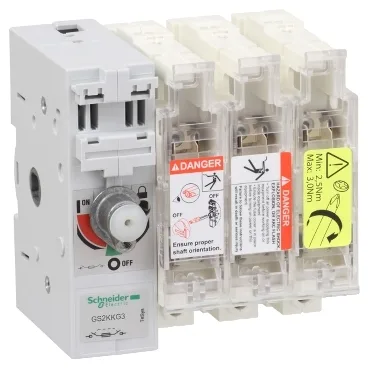
It accepts DIN fuse links in size 00, making it a fused disconnect for motor branch circuits or distribution sub-feeds where coordinated fuse protection is required per IEC 60947-3. Rated operational current (Ie) reaches 125 A at 400 V under AC-23A and AC-23B duty, and 100 A at 690 V under the same categories. For DC applications, it carries 100 A at 440 V with two poles in series per phase, covering both DC-23A and DC-23B loads.
Making capacity is 1 kA at the same voltage — the switch must close onto a fault without welding contacts, and this rating confirms it can. Short-circuit withstand rating is 20 kA, which is the let-through current the device can survive when protected by upstream fuses or a breaker. The rated short-circuit making capacity (Icm) is 100 kA at 400 V with gG fuse protection — this is the peak asymmetrical current the switch can close onto under those conditions. Rated operational power reaches 63 kW at 400 V, 90 kW at 500 V, and 80 kW at 690 V — these are the motor load sizes the switch can handle at each voltage level. The insulation voltage (Ui) is 750 V AC, and impulse withstand (Uimp) is 8 kV, covering 400 V and 690 V systems with margin.
Construction and environment
Mounts to a plate (not DIN rail) via the base. The external left-side operating handle is included. Power circuit connections accept bars up to 20 mm² or ring-terminal lugs from 35 to 95 mm², with a tightening torque of 12 N·m. The 3 NO contacts are part of the switch mechanism. IP20 with the terminal cover fitted — suitable for enclosed panel use, not washdown. Fire resistance is rated at 850 °C for the fuse cover and 960 °C for the body per IEC 60695-2-1. Electrical durability is 1000 cycles under AC-23A and DC-23A, dropping to 200 cycles under AC-23B and DC-23B — the heavier switching duty reduces contact life. Mechanical durability is 10,000 cycles.