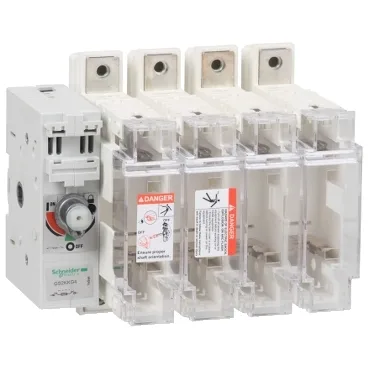
The GS2KKG4 is a TeSys GS switch-disconnector-fuse from Schneider Electric, a 4-pole unit rated for 125 A at 690 V AC-23A and AC-23B, and 125 A at 400 V AC-23A and AC-23B. It accepts DIN fuse links, size 00, and is designed for plate mounting. The part is now obsolete per the manufacturer.
The 1000 A making capacity at the same voltage tells you it can close onto a fault without damage, which matters for infrequent switching duty. The 20 kA short-circuit withstand (with gG fuses) gives the panel builder coordination headroom: upstream protection can be sized to let this unit ride through minor faults while clearing major ones. Rated operational power runs 63 kW at 400 V, 90 kW at 500 V, and 80 kW at 690 V — the non-linear curve reflects the AC-23B duty cycle (motor loads with occasional inrush).
If you need a drop-in replacement with the same footprint and ratings, a parametric search within the TeSys GS family for a 4-pole, 125 A, DIN size 00 switch-disconnector-fuse is the starting point — but the GS2KKG4's specific variant may not have a direct pin-compatible replacement. We can help cross-reference against your panel layout if you send the RFQ with your mounting and wiring constraints.
Integration and mounting notes
Plate-mounted, not DIN rail. The 184 mm width, 162 mm height, and 126.5 mm depth give you the envelope for panel cutout planning. Power circuit terminals accept bars up to 20 mm² or ring lugs 35–95 mm²; torque to 12 N·m. The external left-side operating handle means the switch mechanism extends to the left of the body — account for that clearance when laying out adjacent components. The 4 protected poles (4t) with 4 NO contacts handle three-phase plus neutral or a second load circuit. Mechanical durability is 10,000 cycles; electrical durability varies by duty — 1000 cycles for AC-23A, 200 cycles for AC-23B — so if your application cycles the switch under load frequently, AC-23A gives longer contact life.