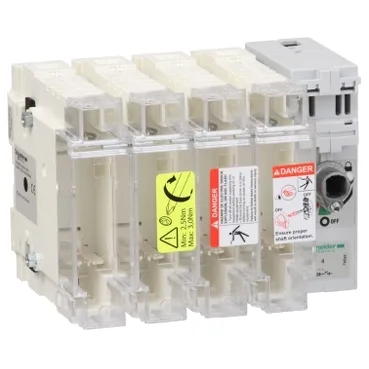
The GS2J4 is a TeSys GS switch-disconnector-fuse — a 4-pole, 100 A rated unit that takes NFC-type fuses in the 22x58 mm size. It's built to IEC 60947-3, so it's a load-break disconnect with a defined making and breaking capacity, not just an isolator. The 100 A rating holds across AC-23A and AC-23B duty at 400 V, 500 V, and 690 V, and it also carries a DC-23A/DC-23B rating at 440 V with two poles in series per phase. That means it handles motor switching (AC-23) and general resistive/inductive DC loads, with the same 100 A thermal current in free air at 40 °C.
Making capacity is 1000 A at the same condition, so it can close onto a fault without welding contacts. Short-circuit withstand is 20 kA, but with gG fuses in the circuit the rated short-circuit making capacity jumps to 80 kA at 400 V — the fuse handles the heavy lifting, the switch-disconnector coordinates with it. For a panel builder, that means the GS2J4 fits into a distribution or motor control center where upstream protection is already sized, and it gives you a visible break for lockout/tagout. The 100 A frame also supports motor loads up to 51 kW at 400 V, 63 kW at 500 V, and 90 kW at 690 V — useful when you're feeding a group of motors or a single large drive from a fused disconnect.
Mounts on a plate — no DIN rail here, so plan for a backplate in the enclosure. Dimensions are 184 mm wide by 162 mm tall by 116 mm deep, which fits a standard gland plate layout for a 4-pole fused disconnect. The operating handle can be mounted externally on the front or the right side, which gives flexibility for enclosure door cutouts. Power circuit terminals accept bars up to 20 mm² or ring-terminal lugs from 25 to 95 mm², with a tightening torque of 12 N.m — that's a solid M8-class connection, not a spring cage. IP20 with the terminal cover means it's touch-safe inside the enclosure but not rated for washdown; keep it behind a locked panel door.
Built to IEC 60947-3, which covers switch-disconnectors and fuse-combination units. Fire resistance is tested to IEC 60695-2-1: the fuse cover withstands 850 °C, the body 960 °C. Rated insulation voltage is 750 V AC, impulse withstand is 8 kV. Electrical durability is 1500 cycles under AC-23A and AC-23B; mechanical durability is 10,000 cycles. That's a solid service life for a panel disconnect that sees daily operation, not just infrequent isolation.