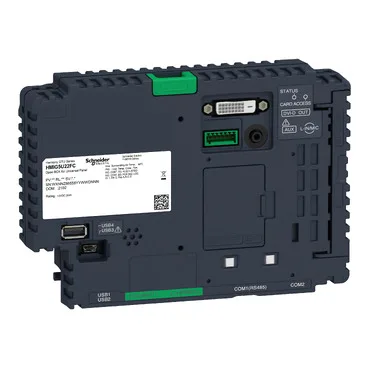
The Schneider Electric HMIG5U22FC is a Harmony GTU Open Box HMI base unit — a panel-mount operator interface running Vijeo Designer software on an ARM Cortex-A9 processor. It ships as a base unit with the HMI software installed, so you add your application project and go. The 12-24 V DC supply feeds the whole assembly, including the built-in real-time clock and the multi-colour LED status indicator on the bezel. Memory is generous for this class: 4 GB of internal RAM and 512 KB of NVRAM backup memory, plus a 32 GB CFast card pre-installed for data storage. Two CFast slots and one SD card slot give you room for recipe archives, alarm logs, and runtime backups without touching the application memory. Connectivity covers the usual panel needs: two RJ45 Ethernet ports at 10/100/1000BASE-T, a serial COM1 on RJ45 for RS-485 (2400-115200 bps), a COM2 on SUB-D 9 for RS-232C/RS-422/RS-485, a USB 2.0 mini-B device port, three USB 2.0 type-A host ports, a DVI-D video output, and an auxiliary terminal block. Protocol support includes Modbus RTU, Modbus TCP/IP, and Uni-Telway — so it talks to most Schneider and third-party controllers without a gateway.
The panel cut-out needs to clear a 7.4 in (188 mm) width and 5.2 in (131 mm) height, with a depth behind the panel of 1.8 in (45 mm). Natural convection cooling — no fan to clog or fail. Operating temperature range is 32 to 140 °F (0 to 60 °C), storage from -4 to 140 °F (-20 to 60 °C), with non-condensing humidity from 10 to 90 %. Pollution degree 2 per IEC 61131-2, so it's fine for most control-room and light-industrial environments. Vibration and shock ratings follow IEC 61131-2: 3.5 mm constant amplitude at 5-9 Hz, then 9.8 m/s² at 9-150 Hz; shock resistance at 147 m/s². That puts it in the range for machinery-mounted panels on pumps, conveyors, and packaging lines — not the heaviest industrial shock, but solid for general factory floor use.
The HMIG5U22FC carries UL 508 listing, CSA C22.2 No. 142 and No. 213, and ANSI/ISA 12-12-01 for Class I Division 2 hazardous locations. It also meets IEC 61131-2 and IEC 61000-4-2 electrostatic discharge immunity at level 3. That means it's accepted in North American and IEC-marketed panels, including areas where flammable gases or vapours may be present under abnormal conditions.