Production status leads — what the lifecycle signal means
The ILE2P661PB1A6: Marking CE and the IEC 61800-3 / EN 50178 / EN/IEC 60068 standard stack carry through to the ILE short-name series, so the unit slots into second-environment panels on a normal industrial grounding scheme without a separate filter budget on the design review.
Mechanical envelope — flange, shaft, worm gear reduction
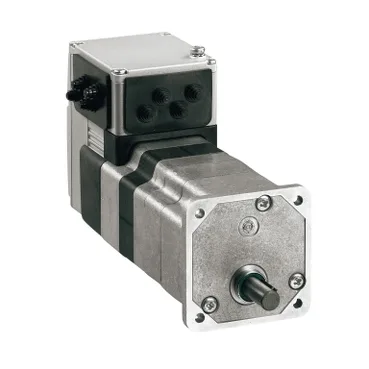
Flange mounting on a 66 mm flange face, 229 mm overall length, with a hole-type shaft end and no second shaft — the kind of body that drops onto an existing bracket when the original actuator geometry is held, so a like-for-like swap rarely forces new machining. Internal worm gear, 3 stages, 54:1 ratio (1715:32) paired with medium speed and medium torque winding — the gearhead absorbs the back-driving load on vertical axes without slipping, and the reduction lets the motor spin where it wants to rather than where the load wants to.
Torque, speed, current — sizing the BOM line to the load
75 rpm nominal at 24 V and again at 48 V (the drive is happy on either rail across the 18–55.2 V supply window), 6 N.m nominal torque on both rails, and 13.93 N.m peak stall torque on both rails — meaning the steady-state work envelope is the same regardless of which DC bus the cabinet already carries, and headroom for acceleration transients is roughly 2.3× nominal. Sustained draw up to 5500 mA continuous and 7000 mA peak, with 45 W at 24 V and 47 W at 48 V nominal output — so power-supply sizing on a 48 V rail lands near 5.5 A continuous plus margin for the inrush that the 7000 mA peak rating implies.
Protection, signals, and the cabinet-side wiring
Built-in protection covers output voltage overload, output short circuit, and safe torque off (STO) — the STO path is the one the safety circuit lands on, so the ILE can sit inside a category-3 stop without an external contactor on the motor leads. Four signals, each usable as input or output, land on a printed circuit board connector — the PCB connector style and the bidirectional I/O count are what determine the cabinet-side harness, and the cable is keyed to the Lexium ILE pin map rather than a generic servo header. Natural convection cooling, shock at 150 m/s², vibration at 20 m/s² across 10–500 Hz, 15–85 % non-condensing humidity, and 1000 m altitude without derating — meaning the drive goes onto an unenclosed machine frame when the surrounding cabinet is omitted, and it still survives near the motor on a vibrating conveyor truss. Six-pole brushless DC motor with a BLDC encoder feedback path and a bearing life of 6000 h — the service-life figure is the MRO planner's replace-on-failure window when the gearbox sees continuous duty, not a maintenance interval the plant can skip.