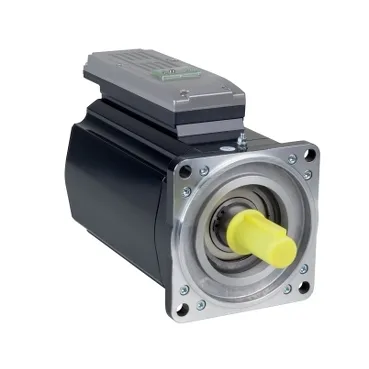
What the ILM1401P12A0000 is
The ILM1401P12A0000 is a single-stack integrated servo drive in the PacDrive 3 family, pairing a 140mm flange motor with an internal drive module and absolute position feedback in one package. SinCos Hiperface multiturn 128 encoding gives 17-bit absolute position across 128 revolutions — no homing sequence on power-up, and the full position word is available immediately over the feedback line to the drive controller. Rated nominal output is 1450 W at 3000 rpm with natural convection cooling and no integral holding brake.
Torque and speed envelope
Continuous stall torque is 7.5 N·m (66.4 lbf·in) — this is the torque the motor sustains indefinitely at zero speed without exceeding its thermal class. Peak stall torque reaches 27 N·m (239.0 lbf·in), roughly 3.6× the continuous figure, giving headroom for acceleration and deceleration pulses in a cyclic motion profile. Nominal torque sits at 4.6 N·m (40.7 lbf·in) at the rated 3000 rpm, placing the mechanical output at 1450 W. Maximum radial force drops with speed — 2210 N at 1000 rpm, 1760 N at 2000 rpm, 1530 N at 3000 rpm — so belt or pulley drives pulling on the shaft at high rpm are the primary load case to validate against the Fr envelope. Axial force is rated at 0.2 × Fr, making thrust loads a secondary concern compared to radial.
Feedback and winding characteristics
The absolute multiturn SinCos Hiperface encoder reports position over a serial link to the drive controller. SinCos provides analog sine/cosine increments within each revolution; the 128-revolution multiturn count extends the absolute range without a mechanical geared overflow. For commissioning, verify the encoder resolution and commutation angle in the PacDrive 3 configuration tool — incorrect polarity or offset here produces a runaway or stall at start-up. Stator resistance at 20 °C is 1.81 Ω phase-to-phase (1.26 Ω phase-to-neutral at 120 °C), and inductance is 19.1 mH phase-to-phase at 20 °C (9.55 mH phase-to-neutral at 120 °C). The winding resistance increase with temperature is significant — a 43% rise from cold to hot — which affects the current-regulated drive's torque output at elevated ambient. The torque constant of 1.6 N·m/A is quoted at 120 °C, so the warm motor delivers slightly less torque per ampere than the same current through a cold winding. Back EMF constant is 108 V/krpm at 20 °C — at 3000 rpm the motor generates roughly 324 V back EMF, which clamps the available bus voltage headroom. Confirm the DC bus is sized below this figure in regenerative or braking phases. Line rated current is 2.9 A; maximum RMS current is 18.8 A — the drive electronics must be rated to supply this peak without thermal folding in short-duration acceleration moves.
Physical form and deployment
IP54 seals the housing against dust and water splashing from any direction — suitable for enclosed cabinet mounting but not for direct washdown or outdoor exposed runs. Natural convection cooling means the drive relies on ambient air flow around the housing; do not recess it in a sealed, unvented enclosure without thermal modelling. The 254 mm body length and 140 mm flange demand a mounting bay with adequate depth clearance and a structural face that supports the 10-inch overhang without deflection under load. The keyed shaft is 24 mm diameter, 50 mm length, with a 40 mm key width — match the key and keyway in the driven load to the shaft fit before bolting the coupling. The 4-hole mounting pattern uses 11 mm holes on a 130 mm centring collar, which is the standard IEC 60072-1 dimension for 140 mm servo motors. Without a second shaft end, only a single-point load coupling is available — confirm the driven element does not impose significant side load at the shaft shoulder.