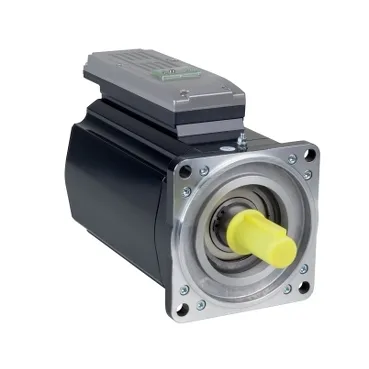
Headline torque and the duty envelope it sets
The Schneider Electric ILM1401P22A0000 is a servo motor integrated drive in the PacDrive 3 family, with a 140 mm flange and a rated continuous output of 1450 W at 4.6 N·m nominal torque and 3000 rpm nominal speed. The 27 N·m peak stall figure is the short-duration ceiling the drive must command for accel/decel profiles; sizing the motion controller to that peak, not the nominal figure, keeps the axis from saturating on every index move. Continuous stall torque is 7.5 N·m at 4.7 A and peak stall is 27 N·m at 18.8 A Irms — the 5.7× peak-to-continuous ratio is what gives the axis its punch for short indexing strokes, and it tells the drive sizing exercise that the amplifier must deliver the Irms figure, not the 2.9 A nominal line current, on demand.
Feedback, electrical constants, and what the drive sees
Position feedback is absolute multiturn SinCos Hiperface at 128 periods of resolution, so the controller gets absolute position on power-up without a homing routine — important on packaging and converting lines where the machine restarts mid-recipe. The torque constant of 1.6 N·m/A at 120 °C and back-EMF constant of 108 V/krpm at 20 °C together set the amplifier gain structure; the cold/hot spread on both constants is the reason servo tuning has to be re-checked once the motor reaches operating temperature. Stator resistance is 1.81 Ω phase-to-phase at 20 °C dropping to 1.26 Ω phase-to-neutral at 120 °C, with stator inductance of 19.1 mH at 20 °C — the copper-heated values are the ones that govern I²R losses and the current-loop bandwidth in a warm-running machine, so thermal modelling should use the 120 °C numbers rather than the datasheet headline.
Mechanical envelope and panel-side mounting
Body length is 254 mm with a 40 mm key width and a 24 mm shaft at 50 mm long, and the 140 mm flange mounts through four 11 mm holes on an international standard flange pattern with a 130 mm centring collar — the flange footprint is the standard PacDrive 3 ILM form factor, so retrofit into an existing ILM machine frame does not require adapter machining. The shaft is untapped with no second shaft end and no holding brake, which means a brake-equipped variant must be sourced separately if the axis needs a fail-safe holding torque on power loss. Cooling is natural convection with IP65 sealing on the body, so the motor mounts inside the machine frame without a fan plenum or external ducting — but the IP65 rating is at the housing, not the cable exit, and the cable gland has to be sealed to the same rating for the wet-side promise to hold. Maximum radial load is 2210 N at 1000 rpm falling to 1530 N at 3000 rpm, with axial load capped at 0.2×Fr; belts and gearboxes that overshoot those numbers at running speed will eat the bearings long before the windings fail.