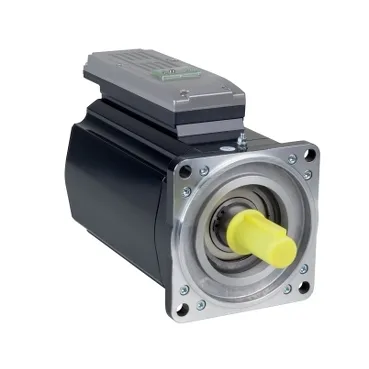
PacDrive 3 ILM, integrated drive on the motor back
The ILM1401P21A0000 is a Schneider Electric PacDrive 3 ILM servo motor with an integrated drive section on the back of a 140 mm flange, which collapses the cabinet-side drive package into the motor body and shortens the panel-side wiring run for a packaging or assembly cell. It is sized for the continuous-duty slot in a PacDrive 3 line: 4.6 N·m nominal torque with a 27 N·m peak stall envelope and a 3000 rpm nominal speed, so the same frame handles the steady-state production move and the short acceleration burst that follows a stop-and-place cycle. The 2.9 A nominal current rises to 18.8 A Irms at peak, which is the figure the upstream DC bus and the PacDrive controller fuse sizing must accommodate, not the 2.9 A continuous number.
Feedback, sealing, and the Hiperface loop
Position feedback is Absolute single-turn SinCos Hiperface with 128 periods of resolution, which the PacDrive controller uses for commutation and absolute position within one turn without a battery-backed encoder — relevant for cells that lose power between shifts and must re-index without a homing run. IP65 sealing with natural-convection cooling lets the motor sit close to the process — a washdown-adjacent conveyor head or a print-mark stage — without forced-air ducting, as long as the continuous stall torque of 7.5 N·m is not exceeded at zero speed with the case stationary.
Flange geometry and shaft interface
The 140 mm international-standard flange has four 11 mm mounting holes on a 130 mm centring collar, with a 24 mm shaft running 50 mm out of the face and a 40 mm key — the standard mating dimensions for a PacDrive 3 ILM gearbox or a direct-coupled load. Untapped shaft end, no second shaft, and no holding brake — coupling is a keyed compression fit and the panel must include a separate 24 V brake supply if the application needs a failsafe stop; this build does not carry one.
Thermal and electrical constants the controller reads
Stator resistance and inductance are quoted at two reference temperatures — 1.81 Ω Ph/Ph at 20 °C and 1.26 Ω Ph/N at 120 °C, with 19.1 mH and 9.55 mH across the same points — which is how the controller's I²T model and torque-constant figure stay valid from a cold start to a warmed-up continuous run. Back-EMF constant 108 V/krpm at 20 °C and torque constant 1.6 N·m/A at 120 °C are the two figures the PacDrive tool uses to back-calculate the bus voltage margin at the rated 3000 rpm — a 108 V constant at full speed is the upper end of what a 400 V-class bus can commutate without field weakening.