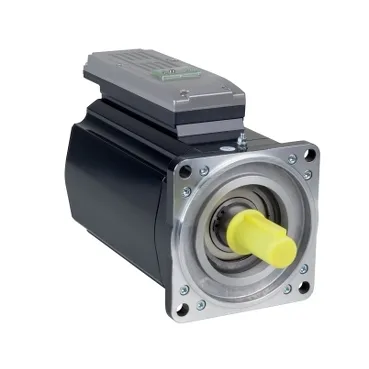
What this motor is, and where it sits on the line
The ILM1402P02A0000 is a Schneider Electric PacDrive 3 series servo motor with an integrated drive, sized as the mid-frame member of the ILM family at a 140 mm flange. It is the kind of part you see in the back of a packaging machine or a high-speed indexing table — a self-contained motor/drive package that takes fieldbus commands and closes the torque loop on its own without a separate amplifier cabinet.
Torque, speed, and what that envelope means on the shaft
Continuous output power is 1910 W and the line-side current is 3.7 A nominal — the peak Irms of 24 A is the short-duration figure the drive will command during acceleration, not the cable-sizing number. The torque constant of 2.6 N·m/A at the 120 °C winding temperature is the working point the drive tunes to once the motor is hot; cold-loop constants look better but don't reflect steady-state behaviour. Back EMF constant of 173 V/krpm at 20 °C means the motor regenerates roughly that voltage per 1000 rpm — above the bus voltage threshold the drive's braking chopper (or an external resistor, sized by the original Schneider documentation) is what bleeds that energy on a fast stop.
Feedback and electrical constants
Feedback is an absolute multiturn SinCos Hiperface encoder at 128 periods of resolution — this is the part that lets the drive know shaft position on power-up without a homing move, which matters on a machine that loses orientation on every E-stop. Stator resistance is 1.9 Ω phase-to-phase at 20 °C and 1.32 Ω at the 120 °C hot winding; stator inductance is 22 mH at 20 °C and 11 mH at hot. Those two figures are what the auto-tune loop measures during commissioning, and they're the reason the motor's cold-resistance check at the cabinet terminals won't read the same value twice. Ten poles and two motor stacks — that pole count is what drives the electrical frequency at a given mechanical speed, and it determines whether the drive's current loop bandwidth is achievable on this frame without hitting the field-weakening ceiling.
Mechanical mounting and load limits
It's an international-standard flange mount with a 140 mm flange, four mounting holes at 11 mm diameter, and a centring collar at 130 mm by 3.5 mm deep. The shaft is 24 mm diameter by 50 mm long, untapped, with no second shaft end and no holding brake — so any brake in the system has to come from the gearbox side, and the coupling has to be keyed or clamp-style rather than tapped onto the shaft. Key width is 40 mm. Maximum radial load Fr is 2430 N at 1000 rpm and drops to 1930 N at 2000 rpm — that is the figure the belt or coupling manufacturer needs, not the bearing's generic catalogue rating. Maximum axial force Fa is constrained to 0.2 × Fr, so any thrust load from a pinion or worm has to be backed off with an external bearing arrangement before it reaches the motor face. Overall length is 12.2 in (309 mm) — that figure is what the cabinet layout has to clear, including the bend radius for the hybrid cable at the back.
Cooling, sealing, and lifecycle status
Cooling is natural convection — no integrated fan, no water jacket — which puts this motor in the IP54 category for sealing rather than the IP65/IP67 washdown ratings you'd see on a fan-cooled or food-grade frame. That rating means dust-protected and splash-resistant, suitable for an enclosure or a sheltered machine zone; it does not survive a direct hose-down. Lifecycle stage is current on the Schneider Electric record, with no official successor cross-referenced in the data we hold for this MPN. Production status on the manufacturer's own record is the controlling number; the unit is sourced to order through independent distribution and quoted against the BOM quantity at RFQ.