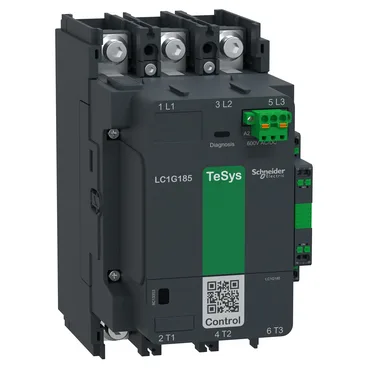
The Schneider Electric TeSys Giga LC1G185XXEN is a 3-pole contactor (3 NO main poles, 1 NO + 1 NC auxiliary) rated for power switching and motor control in utilisation categories including AC-1, AC-3, AC-3e, AC-4, and DC-1 through DC-5. It mounts on a plate with bolted power connections and push-in control wiring. The headline motor power rating is 90 kW at 400 V AC 50/60 Hz under AC-3e duty, which is the standard for squirrel-cage motor starting — that covers a 125 hp motor at 460/480 V 60 Hz on the horsepower side. For heavier duty like plugging or inching (AC-4), it still carries 90 kW at 400 V, so it's not derated for reversing applications.
The built-in bidirectional peak limiting coil technology means you don't need external varistors or RC snubbers for coil suppression — it handles the inductive kick internally, which saves panel space and one wiring step. The coil holds across 600 V AC or DC control circuits, so it works on both common control voltages without a separate power supply. The maximum operating rate is 600 cycles/hour for AC-3 and AC-3e, and 150 cycles/hour for AC-4, so match your duty cycle to the utilisation category. The IP2X front face protection (with shrouds) means the live terminals are finger-safe once shrouded — standard for open panel mounting where accidental contact is a concern. The TH protective treatment adds humidity resistance for non-condensing environments.
This contactor class is the workhorse for motor control centres, pump panels, compressor starters, and conveyor drives in industrial and commercial buildings. The 3-pole configuration handles three-phase motors up to 110 kW at 690 V AC-3, so it covers most medium-voltage motor applications up to 600 V class. The plate-mount design and bolted power connections (up to 185 mm² lugs) mean it's intended for fixed installation in a panel, not DIN-rail snap-on — plan for drilling and torquing to 18 N·m on the power terminals.
It carries approvals to EN/IEC 60947-4-1, EN/IEC 60947-5-1, UL 60947-4-1, CSA C22.2 No 60947-4-1, and JIS C8201-4-1, so it's accepted in North American, European, and Japanese installations. The B10d values (400,000 cycles at nominal load, 3,000,000 cycles at mechanical load per EN/ISO 13849-1) support safety circuit integration where contactor reliability is part of the safety function.