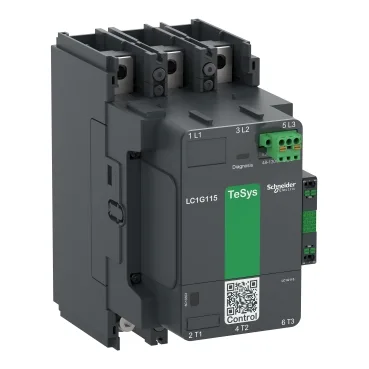
What this contactor is rated for
The Schneider Electric LC1G225LSEN is a 3-pole TeSys Giga contactor rated for motor switching at 110 kW on 400 V AC-3e duty — that is the standard European motor-rating curve, so it handles full-load current for a 110 kW induction motor at that voltage. On AC-4 (reversing, plugging, inching) it still carries 110 kW at 400 V, which is unusual; most contactors derate significantly for AC-4. Built-in bidirectional peak limiting on the coil means you do not need external suppression for the control circuit — the contactor handles its own inrush and back-EMF. Closing time is 40-70 ms, opening 15-50 ms, fast enough for most motor-start and safety-disconnect sequences.
Standards and approvals — what certs mean for your panel
This contactor carries EN/IEC 60947-4-1 (the main contactor standard), UL 60947-4-1, CSA C22.2 No 60947-4-1, and JIS C8201-4-1. That means it is accepted for IEC, North American, and Japanese installations — one part for global machinery if your panel ships to multiple regions. It also meets IEC 60335-1 Clause 30.2 and IEC 60335-2-40 Annex JJ for appliance and HVAC applications, so it works in heat-pump or air-handler circuits that require glow-wire and tracking resistance. Overvoltage category III means it is rated for fixed-installation distribution-level surges — not just downstream equipment. The TH protective treatment indicates tropicalization against humidity and corrosion, which matters for marine or coastal environments. Lifecycle status is current production.
Mounting, wiring, and mechanical limits
Mounts to a plate — not DIN-rail, so plan for bolted or screw-down installation. Power terminals accept bar (25 x 6 mm busbar), ring lugs up to 185 mm², or bolted connections. Tightening torque is 18 N·m (159.3 lbf·in) on the power terminals — that is substantial; use a torque wrench. IP2X front face with shrouds means finger-safe but not sealed; keep it inside an enclosure. Mechanical durability is 8 million cycles — that is a high-endurance frame. Maximum operating rate is 600 cycles/hour for AC-3 and AC-3e, 300 for AC-1, and 150 for AC-4. The AC-4 rate is the limiting factor for reversing or jogging applications.
Thermal and protection data
Power dissipation per pole: 20 W at AC-1 (Ith 330 A), 8 W at AC-3 (Ith 225 A). Average impedance per pole is 0.00015 Ω, so voltage drop is negligible at rated current. Associated fuse ratings: 250 A aM (motor-protection) or 400 A gG (general-purpose) at 400 V; for UL installations, Type J up to 600 V. Rated breaking capacity is 2050 A at 440 V, making capacity 2720 A at 440 V — these are the short-circuit values the contactor can interrupt or close onto.
Safety and auxiliary contacts
Built-in 1 NO + 1 NC auxiliary contact — enough for a feedback signal to a PLC or a holding circuit. Safety reliability: B10d = 400,000 cycles at nominal load (EN/ISO 13849-1), or 3,000,000 cycles with mechanical load only. That is relevant if you are using the contactor in a safety-related control system and need to calculate PFHd.