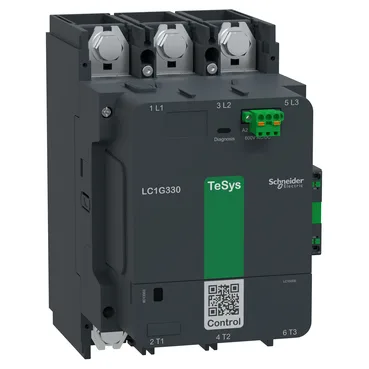
The Schneider Electric TeSys Giga LC1G330XXEN is a 3-pole contactor rated for 330 A in the AC-1 utilisation category, with motor-switching capability across a wide voltage range. At 400 V AC 50/60 Hz it handles 160 kW under AC-3e duty, and at 690 V it reaches 220 kW under the same category. For North American installations, the horsepower ratings span 100 hp at 200/208 V up to 300 hp at 575/600 V 60 Hz. The contactor carries approvals under EN/IEC 60947-4-1, EN/IEC 60947-5-1, UL 60947-4-1, CSA C22.2 No 60947-4-1, and JIS C8201-4-1 / C8201-5-1, covering the major global regulatory frameworks for motor control and switching devices. Built-in bidirectional peak limiting coil technology controls inrush to 350 W DC, with closing time between 40 and 70 ms and opening between 15 and 50 ms. Mechanical durability is rated at 8 million cycles.
The 330 A rating in AC-1 (resistive load) sets the thermal current capacity. For motor loads, the AC-3e rating at 160 kW / 400 V is the figure that governs selection — AC-3e is the enhanced version of AC-3 with stricter test conditions per IEC 60947-4-1, so it gives a more realistic duty cycle for modern motor starting. The AC-4 rating (inching/plugging) at the same 160 kW / 400 V confirms the contactor can handle the higher stress of frequent reversing or jogging without derating. The utilisation category list covers AC-1 through AC-8b and DC-1 through DC-5, which means this contactor is rated for resistive heating loads, motor starting, capacitor switching, and DC loads up to the specified breaking capacity. The rated breaking capacity of 2940 A at 440 V and making capacity of 3830 A at 440 V give the fault-interruption headroom needed for coordination with upstream protective devices. Associated fuse recommendations are 400 A aM or 250 A aM or 500 A gG, with a UL Type L option at 600 A for North American panels. This is the coordination envelope — the contactor will clear a fault without welding if the upstream fuse is within these limits.
Mounting is plate-based with a 45 mm connection pitch between phases. The power circuit uses bolted connections accepting busbars up to 32 x 10 mm or ring-terminal lugs up to 185 mm². Control circuit wiring uses push-in terminals accepting 0.2 to 2.5 mm² solid or stranded wire, or 0.25 to 2.5 mm² flexible with ferrules. Tightening torque for power connections is 35 N·m. The contactor measures 226 mm deep by 140 mm wide by 225 mm high. Front-face IP2X protection is achieved with shrouds per IEC 60529 and VDE 0106. The TH protective treatment indicates tropicalisation for humid environments. Auxiliary contact configuration is 1 NO + 1 NC built-in, with B10d values of 400,000 cycles at nominal load and 3,000,000 cycles at mechanical load per EN/ISO 13849-1 for safety circuit applications.
Overvoltage category III rating means it is suitable for fixed-installation distribution panels where transient overvoltages are controlled by upstream surge protection. The operating rate is 600 cycles per hour for AC-3 and AC-3e, 300 for AC-1, and 150 for AC-4.