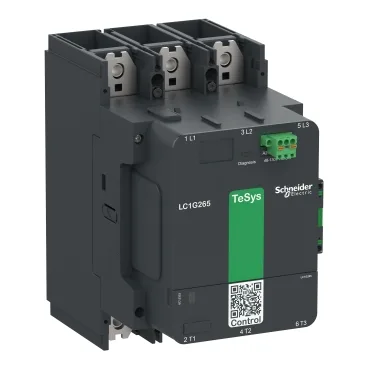
It carries a 500 A rated current (Ith) and handles motor loads up to 355 kW at 690 V AC-3e — that's the utilisation category for standard squirrel-cage motors, so it's the rating that matters for most conveyor, pump, and fan drives. The coil is 200...500 V AC/DC with built-in bidirectional peak limiting, meaning no external suppression module is needed on the control circuit. Mechanical durability is rated at 8 million cycles, and the contactor is certified to EN/IEC 60947-4-1, UL 60947-4-1, and CSA C22.2 No 60947-4-1, so it fits into panels destined for North American or European lines without a second look at the approvals list.
The headline motor power spread tells the story: 147 kW at 230 V AC-3e, 250 kW at 400 V, 355 kW at 690 V. If your line runs 460 V 60 Hz, the horsepower rating is 400 hp — that's the number to match against your motor nameplate. The AC-4 rating (plugging, inching) is lower: 295 kW at 440 V, so if your application reverses or jogs the motor under load, size against AC-4, not AC-3e. Rated breaking capacity is 4600 A at 440 V, and making capacity is 5090 A at 440 V. That's enough to clear a bolted fault on a 500 A feeder without welding the contacts shut — a solid selectivity margin for a distribution panel feeding a motor control center.
Mounts on a plate (not DIN rail) with a 45 mm connection pitch. The power terminals accept bar or busbar up to 32 x 10 mm, or ring lugs up to 185 mm². Tightening torque is 35 N·m on the power connections — that's a serious wrench, not a screwdriver. The front face with shrouds is IP2X, so it's touch-safe once installed in an enclosed panel. Auxiliary contacts are 1 NO + 1 NC built-in, and the safety reliability data gives B10d = 400,000 cycles at nominal load per EN/ISO 13849-1. If you need more aux contacts or a mirror contact for safety circuits, add the LA9G or LAD9G auxiliary block.