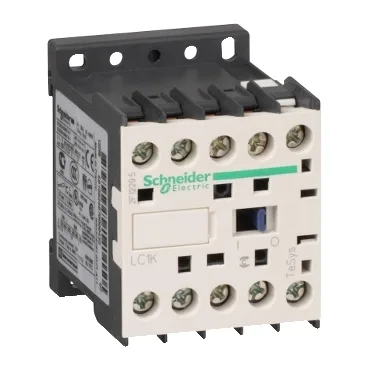
The Schneider Electric TeSys K LC1K12004U7 is a 4-pole contactor with 4 normally-open (NO) main poles, designed for switching resistive loads in control circuits. Its 230-240 V AC 50/60 Hz coil pulls in on a standard panel voltage, and the 20 A AC-1 rating at up to 690 V means it handles resistive heating elements, lighting banks, or transformer primaries without derating worries. The 1.3 W heat dissipation is low enough that you can pack it into a tight DIN-rail enclosure without cooking adjacent components, and the 3600 cycles/hour max rate suits frequent cycling applications like oven zone control.
Rated breaking capacity hits 110 A at 440 V and 70 A at 690 V, so it clears fault currents safely within a 25 A gG or aM fuse limit. The 144 A AC rated making capacity handles the inrush when a cold resistive load energises. Coil hold-in power is only 4.5 VA, but inrush at pickup is 30 VA — make sure your control transformer or PLC output can deliver that surge without voltage sag.
At 1.8 x 2.3 x 2.2 inches (45 x 58 x 57 mm), this contactor occupies minimal DIN-rail space — roughly the footprint of a small ice cube relay. The 4 NO poles give you four independent switching paths in one package, useful for splitting a load across phases or for multi-stage heater control. Operating altitude is 2000 m without derating; above that you'll need to reduce the rated current per IEC guidelines. The overvoltage category III rating means it's suitable for fixed-installation distribution panels, not just downstream equipment.
Safety and reliability data
For functional safety applications, the B10d value is 1,369,863 cycles under nominal resistive load and 20,000,000 cycles under mechanical load per EN/ISO 13849-1. That gives you a solid data point for calculating PFHd in a safety circuit. The contactor also meets V-0 flame retardance per UL 94 and passes shock and vibration testing per IEC 60068-2-27 and IEC 60068-2-6 — up to 15 Gn shock on the Y axis when closed, and 4 Gn vibration from 5 to 300 Hz.