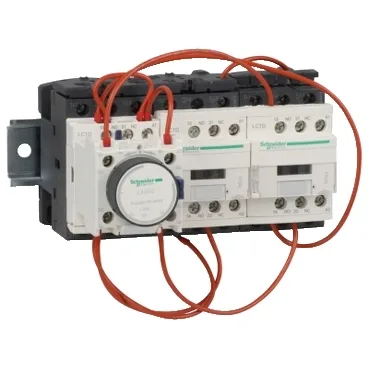
It carries three power poles, each with 3 NO contacts, rated at 18 A. The coil is 220 V AC. This is a pre-wired assembly, meaning the contactors and timer are already interconnected inside the enclosure. It's designed to reduce inrush current during motor startup by connecting the windings in star configuration first, then switching to delta for run.
The 18 A rating is at AC-3 duty, which covers squirrel-cage motor switching — starting, stopping, and running. That's the real-world current the main contacts are rated to break under motor load. Don't size it by the resistive (AC-1) rating; AC-3 is the number that governs motor control fit. This is standard for panel-mounted gear — it lives inside an enclosure that provides the real environmental seal. The storage range extends to -60 to 80 °C, which is wider — that's the handling and transport limit, not the running limit. That's the typical industrial control panel environment — no special coating needed for normal factory air. These are compliance ratings for panel builder certification, not day-to-day selection parameters. Above that altitude, air density drops and the contactor's ability to extinguish the arc is reduced — you'd need to derate the current or use a higher-rated unit. For most installations below 3000 m, this is not a concern.
Integration notes
This is a pre-wired assembly — the interconnections between the star contactor, delta contactor, and timer are already made. You land your line and motor leads at the designated terminals, and wire the 220 V AC coil supply. Verify the timer setting matches your required star-to-delta transition time before commissioning. The 3 x 3P contact configuration means each of the three poles has a normally-open main contact. There are no built-in auxiliary contacts on this unit; if you need feedback to a PLC or status indication, you'll need to add an auxiliary contact block that fits the TeSys D platform. Mechanical robustness specs: the contactor holds closed under 4 Gn vibration (5-300 Hz) and open under 2 Gn. Shock rating is 15 Gn closed, 10 Gn open for 11 ms pulses. That's adequate for most industrial machinery but not for high-shock applications like forging presses or rock crushers without additional isolation.