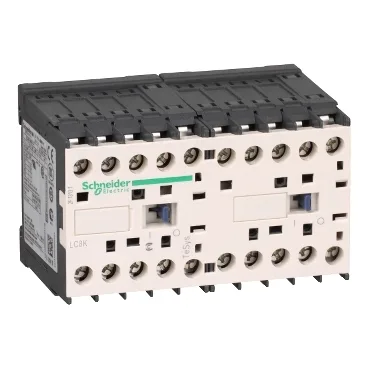
The 110 V AC 50/60 Hz coil draws 3 VA inrush at 20 °C and dissipates 3 W held in. Rated 20 A in AC-1 (resistive) duty at 690 V, it handles resistive loads like heater banks or lighting contactor banks; the AC-1 utilisation category means the contacts make and break at near-unity power factor, so the switching stress is lower than motor (AC-3) duty. Breaking capacity is 110 A at 440 V, 80 A at 500 V, and 70 A at 660...690 V per IEC 60947 — useful for clearing fault currents on the secondary side of a control transformer.
Mounts on a plate or DIN rail — the 90 mm width, 58 mm height, and 57 mm depth fit a standard panel layout. IP20 finger-safe per VDE 0106, so it's suited for enclosed control panels where personnel access is restricted. The solder-pin terminals accept a 1.5 x 0.9 mm busbar cross-section; the preassembled reversing busbar means you don't need to run separate cross-wiring between two contactors for a reversing starter. Mechanical interlocking is built in.
Rated operational current is 20 A at 690 V AC AC-1, derated to 16 A at ambient above 70 °C — that's the continuous current the contacts can carry in resistive service. Electrical durability is 0.3 million cycles at 20 A AC-1 at up to 440 V; mechanical durability is 5 million cycles. The B10d safety reliability figure is 1,369,863 cycles at nominal load per EN/ISO 13849-1, which matters if you're using this contactor in a safety-related control circuit. Rated insulation voltage is 600 V per UL 508 and CSA C22.2 No 14, 690 V per IEC 60947-4-1 — so it's accepted in North American and IEC panels alike. Standards compliance includes IEC 60947, VDE 0660, BS 5424, and NF C 63-110.