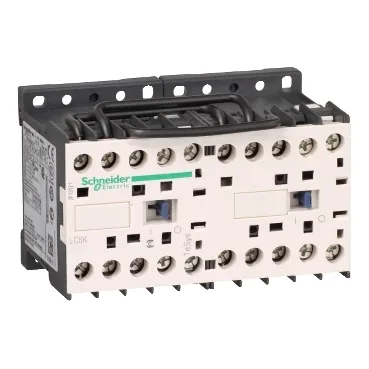
Its 110 V AC 50/60 Hz coil draws 3 VA inrush at 20 °C, with an operating range of 0.85...1.1 Uc and a drop-out band of 0.1...0.75 Uc below 50 °C — so the coil holds reliably down to about 93.5 V and drops out cleanly before 82.5 V, which matters for brownout ride-through in control panels. Rated for AC-1 utilisation category (resistive loads), the contactor is built for switching heating elements, lighting banks, or other non-inductive loads where inrush is minimal. The power circuit carries an average impedance of 3 mΩ at 20 A 50 Hz, which keeps voltage drop low across the poles.
The rated breaking capacity is 110 A at 440 V, 80 A at 500 V, and 70 A at 660...690 V per IEC 60947 — so at a standard 400 V line this contactor can interrupt a fault current of 110 A, which is well above the typical let-through of a 25 A gG or aM fuse (the associated fuse rating). Electrical durability is 0.3 Mcycles at 20 A AC-1 at Ue ≤ 440 V; mechanical durability is 5 Mcycles. For a reversing contactor that may cycle every few seconds in a jogging or inching application, the 3600 cycles/hour maximum operating rate sets the practical ceiling — about one cycle per second sustained. Safety reliability is quantified with B10d values: 1,369,863 cycles under nominal load and 20,000,000 cycles under mechanical load per EN/ISO 13849-1 — useful if this contactor sits in a safety-related stop circuit where you need to calculate the PFHd.
Listed standards include VDE 0660, BS 5424, IEC 60947, and NF C 63-110. The insulation voltage is rated 690 V per IEC 60947-4-1 for the power circuit, with UL 508 and CSA C22.2 No 14 recognition at 600 V — so it is accepted in European, UK, and North American installations. Flame retardance meets V1 per UL 94 and Requirement 2 per NF F 16-101 and NF F 16-102, which is the typical level for rail-transit and building-material fire-safety specs.
Because it is a preassembled reversing contactor with mechanical interlocking built in, there is no direct pin-compatible drop-in from another TeSys K order code — the reversing busbar and interlock are integral to this assembly. If you need a functionally equivalent unit, the same LC8K12xxx family with the same coil voltage is the natural cross-reference.