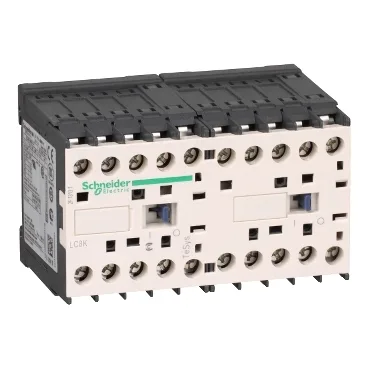
It's a 4-pole, 4 NO contact arrangement, controlled by a 230 V AC 50/60 Hz coil that draws 3 VA inrush at 20 °C. The contactor is rated for AC-1 utilisation category, meaning it's specified for resistive loads, not motor starting (that would be AC-3). Heat dissipation is 3 W, which is modest enough for a crowded enclosure, but the solder-pin terminals (busbar cross-section 1.5 x 0.9 mm) mean you're wiring to a PCB or busbar, not to screw-clamp terminals — plan your termination accordingly.
Ratings That Drive the Decision
The headline rating is the AC-1 utilisation category at 20 A — that 20 A is the conventional free-air thermal current (Ith) for the power circuit, with an average impedance of 3 mOhm per pole at 50 Hz. This tells you the contactor is sized for continuous resistive loads up to 20 A, not for inrush-heavy motor loads. The rated breaking capacity is 110 A at 440 V (per IEC 60947), which is the fault-clearing capability, not the continuous rating. The rated insulation voltage is 600 V per UL 508 and 690 V per IEC 60947-4-1, so it's fine for 480 V systems with margin. Mechanical durability is 5 million cycles, but electrical durability is 0.3 million cycles at 20 A AC-1 — the contacts wear faster under load, so factor that into maintenance intervals if it's cycling frequently.
Mounts on plate or DIN rail (35 mm). The dimensions are 90 mm wide, 58 mm high, 57 mm deep — it takes up about 5.1 modules of DIN rail width, so check your rail budget. IP20 protection per VDE 0106 means it's for inside a panel only; no washdown rating. The mechanical interlock is built in, so you don't need an external interlock module for the reversing pair. Operating time is 30 to 40 ms for coil energisation and NO closing, and 30 ms for de-energisation and NO opening — fast enough for most reversing or transfer applications. The associated fuse rating is 25 A gG or 25 A aM for the power circuit, so fuse it at 25 A for branch-circuit protection.