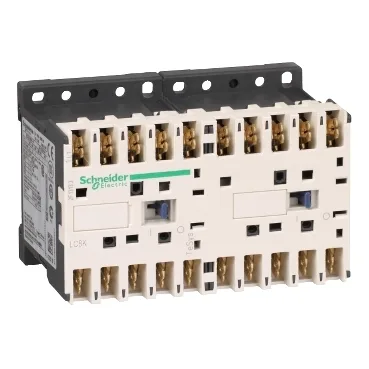
Rated 20 A in AC-1 utilisation category (resistive load) at 690 V, it handles resistive heating, lighting, or transformer loads up to that current; the 110 V AC 50/60 Hz coil pulls 3 VA inrush at 20 °C and operates in the 0.85...1.1 Uc range, dropping out between 0.1 and 0.75 Uc below 50 °C. Mechanical interlocking is built in, so the two contactors in a reversing pair cannot close simultaneously — a requirement for any motor-reversing or changeover circuit where cross-conduction would cause a phase-to-phase fault.
The 20 A AC-1 rating at 690 V is the headline figure, but the breaking capacity tells a fuller story: 110 A at 440 V, 80 A at 500 V, and 70 A at 660...690 V per IEC 60947 — so it can interrupt fault currents well above its continuous rating, which matters when coordinating with upstream protection. Rated insulation voltage is 600 V per UL 508 and CSA C22.2 No 14, and 690 V per IEC 60947-4-1 — the IEC figure governs the 690 V AC-1 rating; the UL/CSA figure covers North American installs where the line-to-line voltage stays under 600 V. Mechanical durability is 5 million cycles; electrical durability is 0.3 million cycles at 20 A AC-1 at up to 440 V — the mechanical figure tells you the contactor body will last through many switching events, but the electrical figure is the one that governs replacement intervals under load. Safety reliability is quantified: B10d of 1,369,863 cycles with nominal load per EN/ISO 13849-1, and 20,000,000 cycles with mechanical load — useful if this contactor sits in a safety-related control circuit where you need to calculate the probability of dangerous failure. Operating time is 30...40 ms for coil energisation and NO closing, and 30 ms for de-energisation and NO opening — consistent with a general-purpose contactor that is not a fast-switching device but is predictable enough for sequencing logic. Heat dissipation is 3 W — modest enough that several contactors can share a small enclosure without forced ventilation, but worth summing if you are packing a dense panel.
Mounts on a rail or plate — the 90 mm width, 58 mm height, and 57 mm depth mean it occupies a standard contactor footprint and leaves room alongside for overload relays or auxiliary contact blocks. Connections are Faston terminals: two cables on a 2.8 mm busbar cross-section, plus one cable on a 6.35 mm busbar cross-section — pre-insulated Faston receptacles are the expected mating half, common in panel wiring. IP20 per VDE 0106 means finger-safe from the front but not protected against moisture — install inside a cabinet with at least IP54 enclosure rating if the environment has condensation or washdown. Associated fuse rating is 25 A gG or 25 A aM for the power circuit — coordinate the upstream fuse or circuit breaker to that value for short-circuit protection.
Meets VDE 0660, IEC 60947, BS 5424, and NF C 63-110 — the IEC 60947-4-1 standard is the one that governs contactors for motor starting and switching, so this part carries the relevant certification for European and most international installs. Flame retardance is V1 per UL 94, plus Requirement 2 per NF F 16-101 and NF F 16-102 — the V1 rating means the plastic housing stops burning within 30 seconds after the flame is removed, which is the standard for panel-mounted components. Protective treatment is TC per IEC 60068 and DIN 50016 — this is a tropicalisation coating that resists humidity and mild corrosive atmospheres, giving it a longer service life in non-air-conditioned industrial environments.
Sourcing reality
The preassembled reversing busbar means this is not a generic contactor you swap with a bare LC1K — verify the busbar pattern matches your reversing starter layout before committing the BOM line.