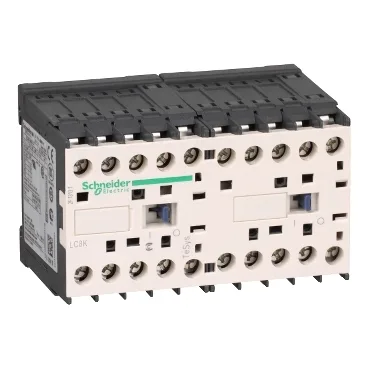
The LC8K12105M7 is a TeSys K reversing contactor from Schneider Electric — a 3-pole unit rated AC-3 at 12 A up to 440 V, with a 220-230 V AC coil. It comes preassembled with the reversing power busbar, so it's a drop-in for a motor-reversing circuit without extra wiring between the two contactors. The IP20 finger-safe enclosure (VDE 0106) is fine for enclosed panel mounting, not for washdown zones. The utilisation categories cover AC-1 (resistive), AC-3 (squirrel-cage motor starting), and AC-4 (plugging/inching) — so it handles both standard motor starts and the more demanding reversing duty where the contactor breaks current while the motor is still spinning. Operating temperature is -25 to 50 °C, storage -50 to 80 °C, and it runs without derating up to 2000 m altitude. Flame retardance meets UL 94 V1 and NF F 16-101/102, which matters for rail and transit applications.
If you're filling a repair or a line-down situation, we can source this part through our multi-supplier network against an RFQ. The key is having the exact order code and quantity ready — the market still carries these, but it's a search, not a shelf pull. For a new design, look at the current TeSys range (TeSys D or TeSys Deca) for a functional equivalent; the footprint and busbar arrangement will differ, so verify the mounting and wiring before committing.
The AC-4 rating (reversing duty) will be lower than the AC-3 figure; if you're doing frequent plugging or inching, check the AC-4 value in the full datasheet to avoid contact welding. The 220-230 V AC coil is a standard industrial control voltage in many regions. Coil hold-in and dropout characteristics follow the VDE 0106 curve; expect dropout around 0.8 x Uc for AC coils. The signalling circuit isolation is rated at 10 MOhm, which is fine for PLC inputs but not for high-impedance leakage-sensitive electronics without a barrier. Mechanical robustness is specified per IEC 60068-2-27/6: the contactor withstands 10 Gn shocks on X/Y axes when closed, 15 Gn on Y/Z when closed, and vibration up to 4 Gn at 5-300 Hz when closed. That's rail and marine-grade shock tolerance — not just panel static.