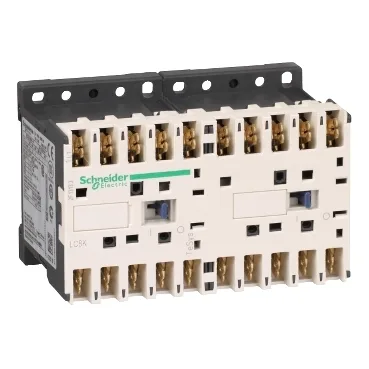
The 24 V AC coil keeps the control circuit at a standard panel voltage. The utilisation categories cover AC-1 (resistive loads), AC-3 (squirrel-cage motors: starting, stopping, reversing during running), and AC-4 (plugging, inching, and reversing at full load). The AC-3 rating is the one that governs motor-switching fit — 12 A at ≤440 V means it suits a motor drawing up to roughly 5.5 kW at 400 V, per standard derating practice. The AC-4 rating, if needed for high-duty-cycle reversing, will be lower; consult the thermal curve for that specific duty.
That depth is the critical dimension for enclosure clearance — the contactor body plus the preassembled busbar and wiring space needs at least 57 mm from the mounting surface to the gland plate or door. IP20 finger-safe per VDE 0106 means it is protected against solid objects larger than 12.5 mm (a finger) but not against moisture; it belongs inside a panel with at least an IP54 enclosure if washdown or condensation is present. The preassembled reversing busbar eliminates the need to source a separate mechanical interlock and busbar kit — the reversing pair is already mechanically interlocked and busbar-connected. This reduces wiring time and eliminates a common assembly error where the interlock is omitted or misaligned. The contactor snaps onto standard DIN rail; no adapter plate required.