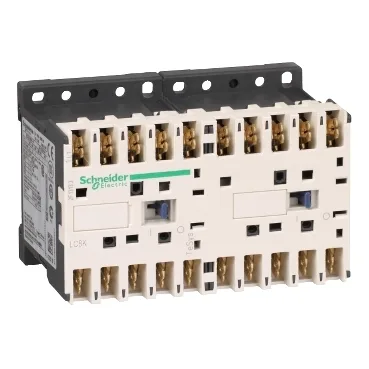
Rated AC-3 at 12 A up to 440 V, it handles reversing motor loads in that current class; the AC-1 and AC-4 utilisation categories mean it also covers resistive loads and inching/plugging duty if the thermal curve fits. The 110 V AC coil is the control voltage, so verify your control transformer matches before the panel gets built.
Lifecycle reality — obsolete, sourced on RFQ
Schneider lists this part as obsolete. No official successor order code appears in the record, so there is no direct drop-in replacement from the manufacturer. If you are freezing a new design, look at current TeSys K or TeSys D reversing contactors with similar pole count and coil voltage, but verify the mounting footprint and busbar arrangement; the preassembled reversing busbar on this unit is not universal across siblings.
Mechanical ruggedness
Rated for shock and vibration per IEC 60068-2-27 and 60068-2-6: the contactor holds closed through 10 Gn on the X axis and 15 Gn on Y and Z axes (11 ms half-sine), and stays open through 6 Gn on X and 10 Gn on Y/Z. Vibration resistance is 4 Gn closed, 2 Gn open across 5–300 Hz. That is solid for machine-mounted applications with moderate impact or continuous vibration — conveyor drives, pump skids, compressor panels.