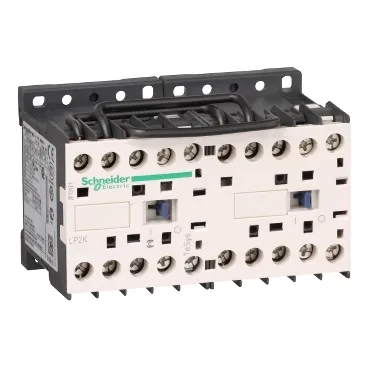
Schneider Electric LP2K12004FD — Contactors

Schneider TeSys K LP2K12004FD Changeover Contactor, 4P, 110

MPNLP2K12004FD
Obsolete

Schneider Electric TeSys K series, LP2K12004FD, changeover contactor, 4 poles, 110 V DC coil, preassembled with reversing power busbar.

Sourced new & surplus through independent channelsAuthenticity-screened · ESD-safe packingListing updated Jul 2026

Specifications

LP2K12004FD — Identification
ParameterValue
Product / component typeChangeover contactor
Series / rangeTeSys
ApplicationResistive load
LP2K12004FD — Ratings & Performance
ParameterValue
Rated operational voltage (Ue)Power circuit: 690 V AC 50/60 Hz
Utilisation categoryAC-1
LP2K12004FD — Contacts & Poles
ParameterValue
Pole configuration4P
LP2K12004FD — Environmental
ParameterValue
IP degree of protectionIP20 conforming to VDE 0106
Operating altitude2000 m without derating
Mechanical robustnessShocks contactor closed, on Z axis: 15 Gn for 11 ms conforming to IEC 60068-2-27 Shocks contactor opened, on Z axis: 10 Gn for 11 ms conforming to IEC 60068-2-27 Vibrations contactor closed: 4 Gn, 5...300 Hz conforming to IEC 60068-2-6 Vibrations contactor opened: 2 Gn, 5...300 Hz conforming to IEC 60068-2-6 Shocks contactor opened, on X axis: 10 Gn for 11 ms conforming to IEC 60068-2-27 Shocks contactor opened, on Y axis: 6 Gn for 11 ms conforming to IEC 60068-2-27 Shocks contactor closed, on X axis: 15 Gn for 11 ms conforming to IEC 60068-2-27 Shocks contactor closed, on Y axis: 10 Gn for 11 ms conforming to IEC 60068-2-27
Protective treatment / pollution degreeTC conforming to IEC 60068 TC conforming to DIN 50016
Flame retardanceV1 conforming to UL 94 Requirement 2 conforming to NF F 16-101 Requirement 2 conforming to NF F 16-102
LP2K12004FD — Approvals
ParameterValue
StandardsBS 5424 IEC 60947 NF C 63-110 VDE 0660
LP2K12004FD — Mechanical
ParameterValue
Width90 mm
Height58 mm
Depth57 mm

Product details

The Schneider Electric TeSys K LP2K12004FD is a 4-pole changeover contactor — a mechanically interlocked pair of contactors in one package, so only one set of poles closes at a time. That mechanical interlock means you can wire it for reversing a motor or switching between two power sources without a separate interlock module or worrying about shoot-through during the transition. The coil is 110 V DC, with an operating range of 0.8 to 1.15 times nominal (88 to 127 V DC) and a dropout band of 0.1 to 0.75 times nominal (11 to 83 V DC). That's a wide dropout margin, which means it won't nuisance-drop on a sagging DC bus — useful if this contactor shares a power supply with other inductive loads. It's rated for AC-1 utilisation category (resistive loads), so think heaters, lighting banks, or transformer primaries — not motor starting. For motor reversing, you'd need the AC-3 rated version in the same TeSys K family.

What the ratings mean in practice

The rated breaking capacity tells you what fault it can clear: 110 A at 440 V, 80 A at 500 V, and 70 A at 660–690 V per IEC 60947. That's not the continuous current — it's the interrupt rating. The continuous thermal current (Ith) is 20 A, with an average power circuit impedance of 3 mΩ at 50 Hz. So at 20 A you're dropping about 60 mV and dissipating 3 W. That 3 W is steady-state heat that has to leave the enclosure — factor it into your panel thermal budget. Mechanical life is 5 million cycles, electrical life is 300,000 cycles at 20 A AC-1 at up to 440 V. The maximum operating rate is 3600 cycles per hour — one per second. That's fast enough for a rapid cycling heater control but not for a servo-style application. The B10d safety figures (1.37 million cycles at nominal load, 20 million at mechanical load) mean it's trackable for safety functions per EN/ISO 13849-1 if you're using it in a guard-monitoring circuit. That saves panel wiring time — no need to build the reversing bridge with separate busbar sections and jumper wires. The screw-clamp terminals accept 1.5 to 4 mm² solid or 0.75 to 4 mm² flexible (0.34 to 2.5 mm² with ferrule). Tighten to 1.3 N·m with a #2 Philips or 6 mm flathead. That's a standard torque for this class — no special tooling needed.

Operating altitude is 2000 m without derating. Above that, you'll need to account for reduced air density affecting arc extinction and dielectric strength. The associated fuse recommendation is 25 A gG (general purpose) or 25 A aM (motor protection) for the power circuit. That's the maximum overcurrent protection; the contactor's own breaking capacity handles faults above that level.

Frequently asked questions

What is the closest alternative to the LP2K12004FD in the TeSys K family?

Within the TeSys K range, the main alternative would be a standard 4-pole contactor (like the LC1K series) plus a separate mechanical interlock, but the LP2K12004FD comes preassembled with a reversing busbar and mechanical interlock as a single unit. If you need AC-3 motor ratings instead of AC-1 resistive, you would need the LP2K motor-rated variant with the same coil voltage.

What compliance documentation is available for the LP2K12004FD?

The contactor carries approvals to BS 5424, IEC 60947, NF C 63-110, VDE 0660, UL 508, and CSA C22.2 No 14. Flame retardance meets UL 94 V1 and French railway standards NF F 16-101/102. The protective treatment complies with IEC 60068 and DIN 50016 for environmental resistance.

What is the depth of the LP2K12004FD?

The depth is 57 mm, with a width of 90 mm and height of 58 mm.

MPN
LP2K12004FD