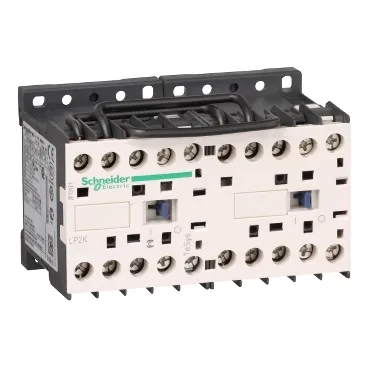
Rated for AC-1 resistive loads at 20 A, it's a control-circuit workhorse for heaters, lighting banks, or any load where inrush is low and the contactor cycles cleanly. The 100 V DC coil means you're feeding it from a DC control supply — common in panel designs that keep AC out of the logic side. Breaking capacity sits at 110 A at 440 V and 70 A at 690 V, so it clears faults decisively on a 400 V line without welding the contacts shut.
The 100 V DC coil has a pickup range of 0.8 to 1.15 Uc and drops out between 0.1 and 0.75 Uc below 50 °C — meaning it holds in solidly at 80 V and releases reliably at 75 V. That dropout margin prevents nuisance hold-ins on a sagging bus. Mechanical durability is 5 million cycles; electrical durability is 300,000 cycles at 20 A AC-1 up to 440 V. For a reversing contactor that sees frequent direction changes, that electrical life is the number to watch — it governs how often you'll swap the unit in high-cycle applications. Safety reliability is quantified with a B10d of 1,369,863 cycles at nominal load per EN/ISO 13849-1, and 20 million cycles under mechanical-only load. If you're using this in a safety-related stop circuit, that B10d figure feeds directly into your PFHd calculation. Heat dissipation is 3 W at 20 °C — negligible for a single unit, but worth summing across a dense row of contactors in a sealed enclosure to avoid cooking the coil.
Mounts on plate or rail (DIN). Screw-clamp terminals accept 1.5 to 4 mm² solid or 0.75 to 4 mm² flexible, with or without ferrules. Two conductors per clamp are allowed, which simplifies daisy-chaining the control supply. Tighten to 1.3 N·m with a #2 Philips or 6 mm flat blade. IP20 finger-safe per VDE 0106 — fine inside a locked panel, not for splash zones. Flame retardance is V1 per UL 94, so it won't sustain a fire if a fault arcs.
Compliant with IEC 60947-4-1, UL 508, CSA C22.2 No. 14, BS 5424, NF C 63-110, and VDE 0660. That covers most industrial control panels destined for North America or Europe without a separate agency review. The insulation voltage is rated 690 V per IEC 60947-4-1 and 600 V per UL/CSA — the lower UL figure governs when the panel ships to a US or Canadian site. Protective treatment is TC per IEC 60068 and DIN 50016 — meaning it's tested for tropical climate resistance (heat, humidity, mold). Fine for unheated warehouses or coastal plants.
Sourcing reality
Because it's a changeover contactor with the busbar pre-fitted, it's not a generic substitute for a plain 4-pole contactor. If your BOM calls for the LP2K12004KD, the busbar and mechanical interlock are integrated — swapping in two separate contactors and a separate interlock kit means re-engineering the panel wiring.