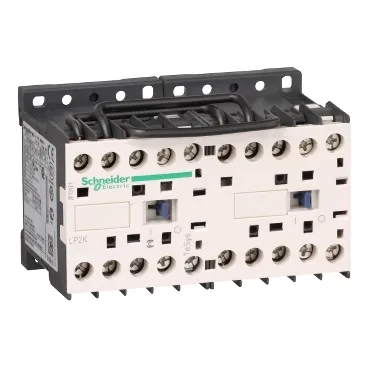
It's a control-circuit contactor rated for AC-1 utilisation (resistive loads) and carries a 200 V DC coil. The 200 V DC coil pulls 3 W at 20 °C and operates within 0.8 to 1.15 Uc for pick-up; drop-out range is 0.1 to 0.75 Uc below 50 °C. That means it holds in cleanly on a regulated 200 VDC bus but drops out reliably if the supply sags below about 150 V — useful for safety circuits where you want a known de-energised state.
Rated breaking capacity is 110 A at 440 V, 80 A at 500 V, and 70 A at 660–690 V per IEC 60947. That's the fault-clearing ability of the contactor itself — it can interrupt those currents without welding its own contacts. For branch-circuit protection, the evidence calls for a 25 A gG or aM fuse upstream on the power circuit. Rated insulation voltage (Ui) is 600 V per UL 508 and CSA C22.2 No 14, and 690 V per IEC 60947-4-1. Electrical durability is 0.3 million cycles at 20 A AC-1 at up to 440 V; mechanical durability is 5 million cycles. The AC-1 rating means resistive loads only — don't use this for motor starting (AC-3) without checking the manufacturer's derating. The 3600 cycles/hour maximum operating rate tells you it's not a high-speed chopper; it's a load-switching contactor for occasional reversals.
Screw-clamp terminals accept 1.5 to 4 mm² solid or 0.75 to 4 mm² flexible (without ferrule), or 0.34 to 2.5 mm² flexible with ferrule. Tightening torque is 1.3 N·m with a No. 2 Philips or 6 mm flat screwdriver. IP20 finger-safe protection per VDE 0106 means it's safe for panel interiors where qualified personnel have access — not for washdown or outdoor use without an enclosure.
Designed and tested to BS 5424, IEC 60947, VDE 0660, and NF C 63-110. Flame retardance is V1 per UL 94, plus Requirement 2 per NF F 16-101 and NF F 16-102 (railway fire-smoke-toxicity standards). Protective treatment is TC per IEC 60068 and DIN 50016 (resistance to tropical climates). Overvoltage category III — suitable for fixed-installation distribution panels. Safety reliability data is provided: B10d of 1,369,863 cycles with nominal load per EN/ISO 13849-1, and 20 million cycles with mechanical load only. That's enough for safety function calculations in machine guarding circuits where the contactor is part of the safety chain.