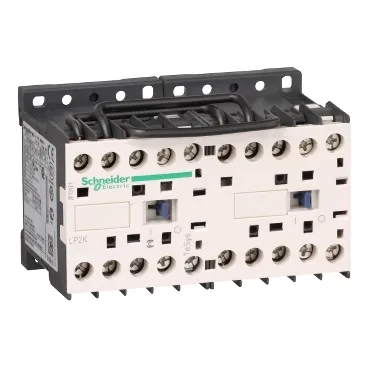
It is designed for control applications where you need to reverse a motor or switch between two power sources without risk of simultaneous closure. The 220 V DC control circuit draws 3 W at 20 °C for both inrush and hold-in, with an operating range of 0.8 to 1.15 Uc for pick-up and a dropout band of 0.1 to 0.75 Uc below 50 °C. Coil energisation to NO closing takes 30 to 40 ms; de-energisation to NO opening takes 10 ms. Breaking capacity is 110 A at 440 V, 80 A at 500 V, and 70 A at 660 to 690 V per IEC 60947.
Mounts on plate or DIN rail. Screw-clamp terminals accept 1 or 2 conductors from 0.34 to 4 mm², solid or flexible with or without ferrules. Tighten to 1.3 N·m using a Philips No. 2 or 6 mm flat-blade screwdriver. The preassembled reversing busbar saves wiring time and reduces the chance of phase-crossing errors during commissioning.
Standards, Safety, and Lifecycle
Compliant with BS 5424, IEC 60947, VDE 0660, and NF C 63-110. Rated insulation voltage is 600 V per UL 508 and CSA C22.2 No. 14, and 690 V per IEC 60947-4-1. Overvoltage category III. Flame retardance meets UL 94 V1 and NF F 16-101/102 Requirement 2. Safety reliability is quantified: B10d of 1,369,863 cycles under nominal resistive load and 20,000,000 cycles under mechanical load per EN/ISO 13849-1. Mechanical durability is 5 million cycles; electrical durability is 300,000 cycles at 20 A, AC-1, up to 440 V.