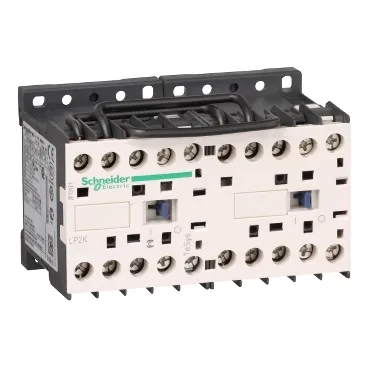
Rated for AC-1 resistive loads, it carries 20 A continuously with a 25 A gG fuse upstream. The coil pulls 250 V DC, and the whole thing dissipates 3 W holding in — modest heat for a panel that's already got a few contactors humming.
AC-1 utilisation category tells you this contactor is built for resistive loads — heaters, lighting banks, or transformer primaries. Don't size it for motor starting (AC-3) without derating; the 20 A AC-1 figure is the thermal continuous current (Ith), not the motor switching current. For a motor reversing pair, you'd typically step up to a TeSys D frame. The 250 V DC coil is a specific control voltage — common in European 220 VDC control buses or battery-backed systems. Verify your control supply: the coil holds between 0.8 and 1.15 Uc (200–287.5 V DC) and drops out between 0.1 and 0.75 Uc (25–187.5 V DC) below 50 °C. If your panel runs 24 V DC, this isn't the one. Mechanical interlocking is built in — the reversing busbar and the contactor's own mechanical interlock prevent both coils from pulling in simultaneously. That's a safety feature, not just a convenience; it keeps you from shorting phases on a reversing starter. Breaking capacity: 110 A at 440 V, 80 A at 500 V, 70 A at 660–690 V per IEC 60947.
Compliance is straightforward: meets IEC 60947-4-1, UL 508, CSA C22.2 No 14, and VDE 0660. Flame retardance is V1 per UL 94, and it carries protective treatment TC per IEC 60068 and DIN 50016 — meaning it's tested for tropical climate and corrosive atmospheres. If you're replacing an older TeSys K reversing contactor, the LP2K12004UD is the direct current-production equivalent. No pinout or footprint change — same 57 mm depth, 90 mm width, 58 mm height.
Mounts on plate or DIN rail — screw clamp terminals accept 1.5–4 mm² solid or 0.75–4 mm² flexible (ferruled down to 0.34 mm²). Tighten to 1.3 N·m with a No 2 Philips or 6 mm flat blade. Two cables per terminal are allowed for daisy-chaining. Operating altitude: 2000 m without derating. Above that, you'll need to account for reduced air density and dielectric strength — but for most panel installs at normal plant elevations, it's fine. Maximum operating rate is 3600 cycles per hour — that's one cycle per second, which is plenty for a reversing starter on a conveyor or a transfer switch. Mechanical durability is 5 million cycles; electrical durability at 20 A AC-1 is 300,000 cycles.