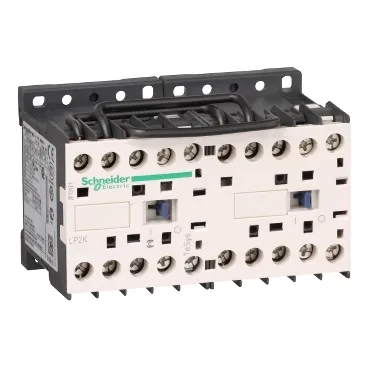
It's a single part that replaces the two-contactors-plus-interlock-kit build for a reversing motor starter or transfer switch, saving panel space and wiring time. Rated for AC-1 resistive loads at 20 A, it's sized for heater, lighting, or transformer switching where the load current stays steady through make and break. The 20 V DC coil draws 3 W holding power and operates in 30–40 ms on closure.
The 4-pole configuration lets you switch three phases and the neutral in a single device — common for single-phase or three-phase changeover applications where the neutral must follow the phases. The mechanical interlock between the two contactor halves is built in, so there's no risk of both sides closing simultaneously and shorting the supply. Insulation voltage is 690 V to IEC 60947-4-1 and 600 V to UL 508, so it's comfortable on 400 V or 480 V systems with margin. The 20 V DC coil is a non-standard control voltage — verify your control transformer or PLC output card supplies exactly that. Coil hold range is 0.8–1.15 Uc (16–23 V DC), dropout at 0.1–0.75 Uc (2–15 V DC). If your panel runs 24 V DC, this part won't drop out reliably; you'd need the 24 V DC coil variant. Mechanical durability is 5 million cycles; electrical durability is 300,000 cycles at 20 A AC-1. For a reversing starter cycling a conveyor once every 30 seconds, that's about 5 years of 24/7 operation on the mechanical side — the electrical contacts will wear first under load.
Mounts on plate or DIN rail — the 90 mm width × 58 mm height × 57 mm depth footprint fits a standard 4-module DIN-rail slot. Screw-clamp terminals accept 1.5–4 mm² solid or 0.34–2.5 mm² flexible with ferrule, torqued to 1.3 N·m with a No. 2 Philips or 6 mm flat blade. IP20 finger-safe per VDE 0106 — fine inside a locked panel, not for washdown or outdoor. The preassembled reversing busbar means you don't need to wire the phase reversal between the two contactors; just land your line and load cables.
If you're sourcing for a new design and the 20 V DC coil is a constraint, check the TeSys K range for 24 V DC or 110 V AC coil variants — same footprint, same busbar kit, different coil voltage.
Certified to IEC 60947, BS 5424, VDE 0660, and NF C 63-110. Flame retardance meets UL 94 V1 and NF F 16-101/102. Protective treatment conforms to IEC 60068 and DIN 50016 for tropicalized environments. Safety reliability data is published: B10d of 1,369,863 cycles at nominal load and 20 million cycles at mechanical load per EN/ISO 13849-1 — useful if you're calculating PFHd for a safety circuit that uses this contactor as a switching element.