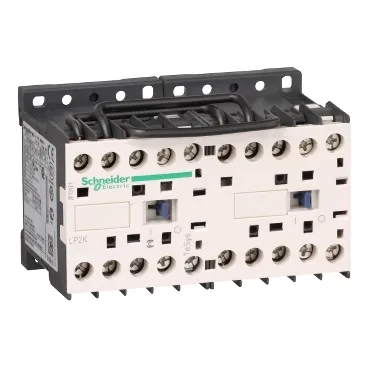
The Schneider Electric LP2K1210MPD is a TeSys K reversing contactor — a 3-pole unit rated for AC-3 duty at 12 A up to 440 V, with a 230 V DC coil and one normally open auxiliary contact. It ships preassembled with the reversing power busbar, so you avoid the extra labour of wiring a mechanical interlock and busbar set between two separate contactors. That busbar is what makes it a reversing contactor rather than a pair of line contactors: it enforces the electrical and mechanical interlock that prevents both directions being energised simultaneously, which would be a phase-to-phase fault on a motor winding.
The AC-3 rating of 12 A at 440 V governs motor switching — that is the utilisation category for starting and stopping squirrel-cage induction motors under load. The same contactor also carries AC-1 (resistive load) and AC-4 (plugging/inching) ratings, but the AC-3 figure is the one that decides whether this part holds the unit on the grid for a typical reversing drive. At 12 A AC-3, it covers motors up to roughly 5.5 kW at 400 V three-phase, provided the ambient stays within the -25 to 50 °C operating range. Above 50 °C you would need to derate, but the ledger does not carry the derating curve — that lives in the TeSys K application note. The 230 V DC coil is a point to watch: if your control voltage is 24 V DC or 110 V AC, this is not the coil variant you want. The coil draw at 230 V DC is modest, but verify your DC supply can deliver the inrush without droop. It belongs inside an enclosure rated for the environment. The mechanical robustness figures are solid: 15 Gn shock on the Z axis with contacts closed, 10 Gn with contacts opened, and vibration survival at 4 Gn closed, 2 Gn opened. That is enough for most industrial panels on a machine base, but if the contactor is mounted directly on a vibrating conveyor frame, you may want to check the resonant frequency against the 5–300 Hz sweep.
The footprint is 90 mm wide by 58 mm high by 57 mm deep. The busbar and interlock are integrated.