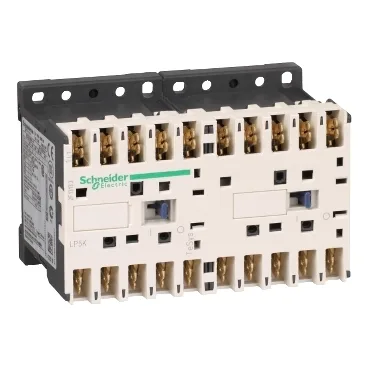
The AC-1 rating (20 A) is the continuous resistive load it can handle — this is the number to match against your heater, lighting, or resistive bank current. For motor or inductive loads, you'd need the AC-3 rating (not listed here), so this contactor is not a general-purpose motor starter. Rated breaking capacity reaches 110 A at 440 V, 80 A at 500 V, and 70 A at 660–690 V per IEC 60947 — these are the fault-clearing values, not the continuous rating. Mechanical durability is 5 million cycles; electrical durability is 0.3 million cycles at 20 A AC-1 up to 440 V. The B10d safety figure of 1,369,863 cycles at nominal load (per EN/ISO 13849-1) matters if this contactor is in a safety-related control circuit. Operating time: coil de-energisation and NO opening takes 10–20 ms; coil energisation and NO closing takes 30–40 ms. Maximum operating rate is 3600 cycles per hour.
Mounts on a rail or plate. Connections are Faston terminals: two cables on a 2.8 mm busbar tab, one cable on a 6.35 mm tab. IP20 finger-safe protection per VDE 0106. Mechanical interlocking is built in — this is a reversing contactor assembly, so the interlock prevents both contactors from closing simultaneously. Associated fuse rating: 25 A gG or 25 A aM for the power circuit.
Standards compliance includes IEC 60947, VDE 0660, BS 5424, NF C 63-110, UL 508, CSA C22.2 No 14. Flame retardance is V1 per UL 94.