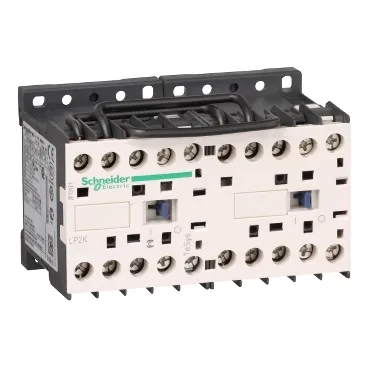
It's a control-circuit device rated for AC-1 resistive loads, meaning it's built for switching heaters, lighting banks, or other non-inductive circuits where the current stays in phase with voltage. The 125 V DC coil pulls in reliably across 0.8 to 1.15 Uc and drops out between 0.1 and 0.75 Uc, which gives you a clean hold-in margin on a regulated DC bus.
The AC-1 rating is the headline here: this contactor is specified for resistive loads, not motor starting. If you're swapping in a reversing contactor for a conveyor or pump, check that the load is resistive or that you're staying within the AC-1 thermal current limits — the average impedance is 3 mOhm at Ith 20 A 50 Hz, so the power circuit runs cool under continuous resistive load. The rated breaking capacity hits 110 A at 440 V, 80 A at 500 V, and 70 A at 660 to 690 V, all per IEC 60947. Insulation voltage is rated at 690 V per IEC 60947-4-1 and 600 V per UL 508 and CSA C22.2 No 14, so it fits into North American and IEC panels alike. The overvoltage category is III, which covers fixed-installation distribution-level transients — standard for a panel-mounted contactor.
Mounts on a rail or plate — the 90 mm width and 57 mm depth fit a standard DIN-rail footprint, so it slots into a 35 mm rail alongside other TeSys K contactors and overload relays. The screw-clamp terminals accept 1.5 to 4 mm² solid or flexible wire (0.34 to 2.5 mm² with ferrules), and the tightening torque is 1.3 N.m with a No 2 Philips or 6 mm flat screwdriver.
Compliance documentation covers IEC 60947-4-1 for contactors, UL 508 for industrial control equipment, and CSA C22.2 No 14. The flame retardance rating is V1 per UL 94, plus it meets NF F 16-101 and NF F 16-102 Requirement 2 for rail-vehicle fire behavior. Protective treatment is TC per IEC 60068 and DIN 50016, which covers tropical climate resistance — so it's suitable for humid or coastal panel environments without extra conformal coating.