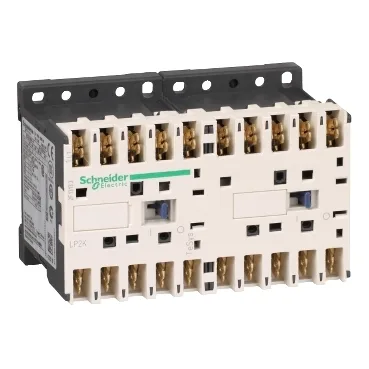
It is rated for AC-1 utilisation category, meaning it is designed for switching resistive loads — heaters, lighting banks, or similar loads where inrush current is minimal. The contactor is listed as current production.
The rated breaking capacity is 110 A at 440 V, 80 A at 500 V, and 70 A at 660...690 V, all per IEC 60947. The associated fuse rating is 25 A gG or 25 A aM for the power circuit, so size the branch fuse accordingly. Rated insulation voltage is 690 V per IEC 60947-4-1 and 600 V per UL 508 and CSA C22.2 No 14, so it fits standard North American and European 480/400 V panels with headroom. The control circuit voltage limits are 0.8...1.15 Uc for operation and 0.1...0.75 Uc for drop-out at <50 °C — the coil holds in at 19.2 VDC and drops out between 2.4 and 18 VDC, which is a wide dropout margin for noisy DC supplies. Electrical durability is 0.3 million cycles at 20 A AC-1 at Ue ≤ 440 V; mechanical durability is 5 million cycles. The B10d safety reliability level is 1,369,863 cycles at nominal load per EN/ISO 13849-1, and 20,000,000 cycles with mechanical load — useful if this contactor is part of a safety circuit where the B10d value drives the SIL/PL calculation. Heat dissipation is 3 W at 20 °C, and inrush power is also 3 W. That is low enough that thermal buildup in a crowded enclosure is not a concern, but the 3 mOhm average impedance at 20 A 50 Hz means the power circuit runs cool under continuous load.
Connections are Faston terminals: two cables on a 2.8 mm busbar cross-section, and one cable on a 6.35 mm busbar cross-section. The preassembled reversing busbar simplifies wiring for reversing starter applications — no separate busbar kit to order.