The 110 V DC coil includes a built-in bidirectional peak limiting diode suppressor, which simplifies panel wiring by eliminating the need for an external flyback diode across the coil.
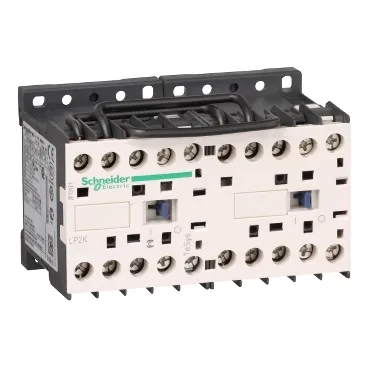
Rated in AC-1 (resistive load) at 20 A, with a rated insulation voltage of 690 V per IEC 60947-4-1 and 600 V per UL 508. The AC-1 rating governs continuous current for resistive loads like heaters or lighting; for motor loads you would derate per the AC-3 curve. Breaking capacity is 110 A at 440 V, 80 A at 500 V, and 70 A at 660–690 V — sufficient to clear faults on a 20 A resistive circuit without welding the contacts. Mechanical interlocking is built in, so the two contactor halves cannot close simultaneously — critical for reversing applications where a simultaneous closure would short the phases. Electrical durability is 0.3 million cycles at 20 A AC-1, mechanical durability 5 million cycles. Maximum operating rate is 3600 cycles per hour, which suits frequent reversing duty on conveyor or transfer applications. The control circuit operates from 110 V DC, with an operational voltage range of 0.8 to 1.15 Uc (88 to 126.5 V DC) and dropout between 0.1 and 0.75 Uc (11 to 82.5 V DC). Coil inrush and holding power is 3 W at 20 °C — useful for sizing the DC supply. Heat dissipation is also 3 W, so no special ventilation is needed in a standard IP20 enclosure.
Where this class of part is used
Changeover contactors of this size are common in motor-reversing starters for conveyors, hoists, and valve actuators, as well as in automatic transfer switches for backup power circuits. The preassembled reversing busbar saves panel space and wiring time compared to building the reversing bridge from separate contactors and links. Mounts on DIN rail or plate per the listed support options.