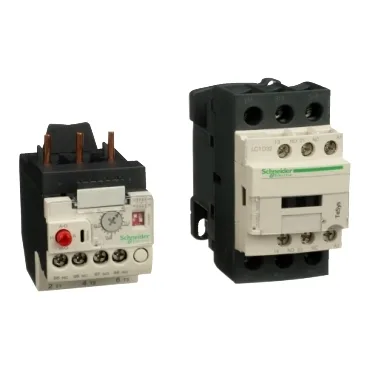
The LR9D32KITD32G7: The utilisation categories tell you what loads it can handle: AC-3 for squirrel-cage motors (the main use), AC-1 for resistive loads, and AC-4 for reversing or inching duty. The tripping threshold is 1.25x In per IEC 60947-4-1, meaning it will trip at 125% of the set full-load current — standard for motor overload protection. The motor power range spans multiple voltage systems, so it's a single SKU that covers 380-440 V and 480-500 V three-phase plants equally. The adjustable trip class (5 to 30) lets you match the overload curve to the motor's thermal capacity — Class 10 for standard motors, Class 20 for high-inertia loads like fans, Class 30 for very long starts like crushers.
This starter carries UL 60947-4-1, IEC 60947-4-1, CSA C22.2, and GB 14048.4 approvals, so it's accepted in North American, European, and Chinese installations. The flame retardance is V1 per UL 94, and the glow-wire test passes at 1562 °F (850 °C) per IEC 60695-2-1. Electromagnetic compatibility is covered: surge withstand 2 kV common mode per IEC 61000-4-5, electrostatic discharge immunity to 8 kV per IEC 61000-4-2, radiated immunity to 10 V/m per IEC 61000-4-3, and fast transient immunity to 2 kV per IEC 61000-4-4. The protective treatment is TH per IEC 60068-2-30, meaning it's treated against tropical humidity conditions.
Mounting options include under a contactor plate or on a rail with specific accessories. The dimensions are 3.1 in (79.9 mm) deep, 1.8 in (45 mm) wide, and 2.9 in (72.5 mm) tall — a compact footprint that fits standard DIN-rail enclosures. Power circuit terminals accept up to 16 mm² solid or flexible wire without cable end, tightened to 3.1 N·m. Control circuit terminals accept up to 2.5 mm² at 0.8 N·m. Operating altitude is 2000 m without derating. Storage temperature range is -76 to 176 °F (-60 to 80 °C). The mechanical robustness specs show it handles vibrations up to 6 Gn at 10-150 Hz and shocks of 15 Gn for 11 ms — typical for industrial panel mounting near rotating machinery.