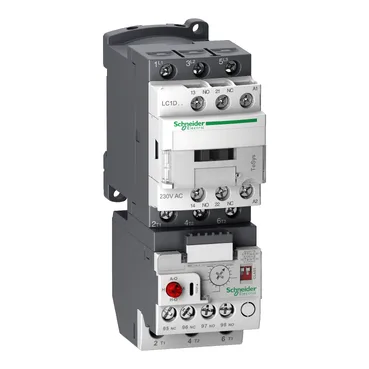
It's rated for 7-11 kW on 380-440 V three-phase, with an adjustable trip class from 5 to 30 — meaning you set how fast it trips on overload, matching the motor's thermal curve. It's designed for AC-3 (squirrel-cage motor starting), AC-4 (plugging/inching), and AC-1 (resistive) loads — so it handles motor duty cycles and straight resistive heaters.
The motor power range is the headline: 7-11 kW at 380-440 V three-phase. That's a 10-15 HP motor roughly, common for pumps, fans, and small conveyors. The 1.25 In tripping threshold per IEC 60947-4-1 means it'll hold 125% of the full-load current setting before the bimetal trips — standard for motor protection. The thermal overload class is adjustable from 5 to 30. Class 10 is the default for most standard motors; Class 20 for high-inertia loads like crushers; Class 5 for submersible pumps that need fast trip. You dial it in with the gray knob on the front. Rated insulation voltage is 1000 V on the power circuit, 690 V on the signalling circuit — that's plenty for 480 V systems and leaves headroom for 600 V class. Dielectric strength is 6 kV at 50 Hz, so it'll pass a hipot test without issue. The TH protective treatment per IEC 60068-2-30 confirms it's tested for damp heat cycling.
Mounts under the contactor plate or on a DIN rail with the right accessories. Tighten power terminals to 3.1 N·m, control to 0.8 N·m — don't overtighten or you'll strip the screw clamp. Dimensions are 45 mm wide, 72.5 mm tall, 79.9 mm deep — that's a 1.8-inch footprint on the DIN rail, so it fits in a standard 8-inch deep enclosure with room for wiring gutters. The control circuit has a red push-button stop and manual reset, plus two microswitches for the adjustable trip class. The red knob handles automatic reset; the gray dial sets the full-load current. All adjustments are on the front face, accessible with the panel door closed.
For compliance, it carries UL 60947-4-1, IEC 60947-4-1, CSA C22.2, and GB 14048.4 listings. That covers most North American and European panel shop requirements.