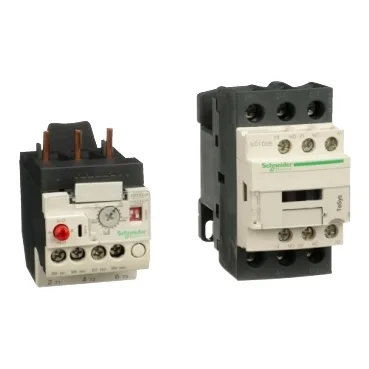
It protects a three-phase motor by monitoring current and tripping on sustained overload, with a tripping threshold of 1.25 In per IEC 60947-4-1. The adjustable thermal overload class covers 5 through 30, letting you match the relay to the motor's thermal time constant and the starting duty — Class 10 for standard starts, Class 20 for heavy starts like crushers or conveyors, and Class 30 for very long acceleration times.
The motor power range spans 4 to 6 kW on 200-240 V three-phase, 7 to 11 kW on 380-440 V, and 15 to 25 kW on 525-690 V. The utilisation categories include AC-3 (squirrel-cage motors, starting and stopping under load) and AC-4 (plugging and inching), so it's rated for the harder duty cycles, not just resistive loads. The rated insulation voltage for the power circuit is 1000 V, giving headroom for 690 V systems without derating.
Controls and adjustments
The front face carries a red push-button for stop and manual reset, a white microswitch set for auxiliary signalling, a red knob for automatic reset mode, and a gray dial for full-load current adjustment. The automatic reset time is fixed at 1.5 to 4 minutes — long enough to prevent a nuisance restart on a hot motor, but short enough to clear a stalled conveyor jam. The relay mounts under a contactor or on a DIN rail with specific accessories, so it integrates into standard panel layouts.