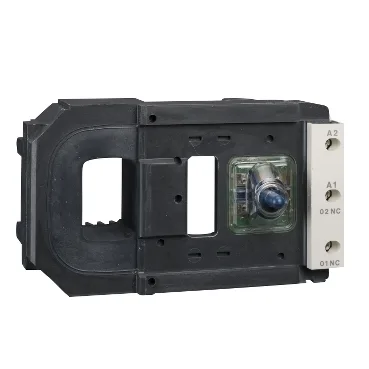
Part identity and control voltage
The LX9FK925 is a specific contactor coil from the Schneider TeSys F range, designed as a replacement or build-in coil for TeSys F contactors. It accepts dual control voltage: 110 V AC across 40-400 Hz, or 110 V DC, making it usable in both AC and DC control circuits without a separate rectifier.
Switching dynamics and thermal budget
Opening time is 60 ms, closing time is 50 ms — the coil pulls in faster than it drops out, which matters for contactor sequencing in reversing or star-delta starters where overlap timing is critical. Heat dissipation runs 15 to 18.3 W once the contactor is held in. The coil resistance shifts from 24 Ω inrush to 204 Ω holding at 68 °F (20 °C), so the holding current is roughly one-eighth of the inrush — the coil's own thermal load drops significantly after pickup. Inrush power is 550 VA at 40-400 Hz (68 °F), dropping to 31 VA holding. The closed-circuit inductance is 1.1 H, which limits the AC holding current and keeps the coil from overheating on continuous duty.
Durability and operating envelope
Mechanical durability is rated at 10 million cycles — the coil itself is not the wear item in a TeSys F contactor; the main contacts and arc chambers will typically need replacement first in high-cycle applications like conveyor or pump cycling. Maximum operating rate is 3600 cycles per hour at 158 °F (70 °C). In a panel with multiple contactors ganged together, the cumulative heat from adjacent coils can push ambient above that ceiling — derate the operating rate or add ventilation if the panel runs hot. Ambient operating range is 23 to 131 °F (-5 to 55 °C). The coil's drop-out voltage band is 0.3 to 0.5 Uc at 131 °F — if the control supply sags below 33 V AC on a 110 V line, the contactor drops out, which can cause nuisance tripping in brownout conditions.
Lifecycle and sourcing reality
The LX9FK925 is marked obsolete by Schneider. No official successor order code is recorded — the TeSys F coil range has been superseded by the TeSys Deca series, but the mounting footprint and coil termination differ, so a direct drop-in replacement is not available without contactor replacement. Sourced through independent distribution channels against an RFQ. Availability is lot-specific — confirmed at quote time. The coil carries no built-in suppressor module; if the control circuit uses a PLC output or solid-state relay, an external RC snubber or flyback diode should be added across the coil to protect the switching device.