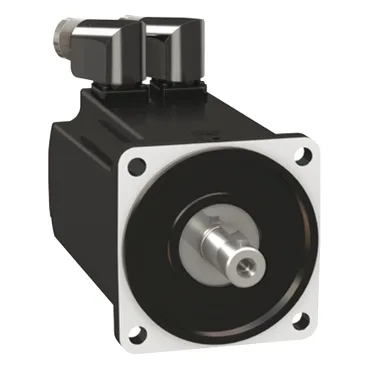
Motor dynamics and load matching
The MH31002P12F2200: Nominal torque is 5.67 Nm, and the continuous stall torque holds at 6 Nm across the 115–480 V three-phase input range. The peak stall torque reaches 18 Nm — roughly 3.2× the continuous rating — giving the motor headroom for acceleration transients during pick-and-place or indexing moves without saturating the drive's current limit.
Encoder feedback and brake integration
The motor carries a Multiturn SinCos Hiperface encoder — this is a high-resolution absolute feedback protocol that reports position over 4096 revolutions without needing a home cycle on power-up. For a vertical-axis application or a gantry that must hold position when the drive is disabled, the holding brake delivers 5.5 Nm static torque and draws 12 W to release. The brake pull-in power is low enough that a standard 24 VDC power supply can drive it through the drive's brake control relay without a separate brake rectifier. The back EMF constant is 78 V/krpm, and the torque constant is 1.19 Nm/A at 120 °C copper temperature. The stator resistance is 1.97 Ω with an inductance of 8.24 mH — the L/R time constant of about 4.2 ms means the current loop bandwidth on the drive should be set above 200 Hz to avoid phase lag at the motor's electrical frequency.
Mechanical interface and environmental sealing
The motor flange is the international standard 100 mm (3.9 in) pattern with a 95 mm centring collar and 9 mm mounting holes — this matches the common IEC frame size for servo motors in the 1–3 kW range. The shaft is 19 mm diameter with a parallel key, 40 mm shaft length, and a 6 mm key width. The overall body length is 202.3 mm, which fits within the envelope of most existing machine designs without a frame-size jump. IP65 protection covers the motor housing and connector interface — the rotatable right-angled connectors let the cable exit in any of four orientations, which simplifies routing in tight cabinet panels. Natural convection cooling means the motor relies on its own surface area and the machine's airflow; no external fan or forced air is needed, but the maximum radial force at the shaft nose drops from 990 N at 1000 rpm to 580 N at 5000 rpm, so a belt-drive application at high speed must account for the reduced bearing load capacity.