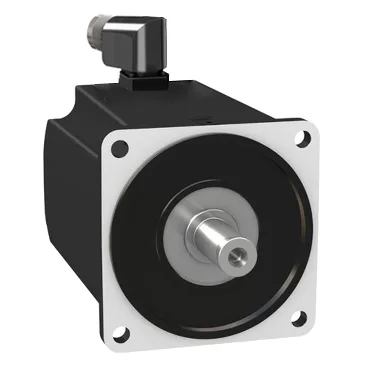
What this MPN is
The MH31903P11F2200 is a Schneider Electric MH3-series three-phase AC servo motor with a 190 mm international-standard flange — the mid-frame sibling of the Lexium MH3 line built around the 10-pole stator, which sets the electrical cycle speed of the rotating field. It is paired with the LXM52 or LXM62 servo drive platforms and carries a single-turn SinCos Hiperface encoder on the non-drive end, which means absolute position feedback to the drive on power-up without a homing move — relevant for safety-rated machinery where the controller must know rotor angle before enabling motion.
Torque envelope and holding brake
Peak stall torque reaches 330 N.m with 124.5 A Irms available for acceleration peaks, so the dynamic reserve is roughly 5× continuous — the headroom that lets the drive push hard into a short move without saturating the current loop. The integrated holding brake pulls in at 25 W, which is the 24 VDC coil load the drive's brake output must switch; for vertical axes the brake releases only when the drive commands torque, so a brake-supply drop faults the axis down safely.
Power, speed and rotor inertia
Continuous power is 9.56 kW and nominal output power is 7.75 W at the 400/480 V drive rails — the nominal figure is the per-speed mechanical point the catalog benchmarks against, while 9.56 kW is the thermal ceiling the winding can sustain at the rated 9560 W continuous dissipation.
Shaft, feedback and mechanical integration
The 38 mm parallel-key shaft protrudes 80 mm with a 10 mm key width — the standard coupling and gearbox mounting profile for this frame, no second-shaft extension on the encoder side so the feedback housing stays compact inside the machine envelope. Maximum radial load is 3300 N at 1000 rpm, falling to 3100 N at 4000 rpm — the bearing-load derating curve a belt or pinion drive must respect, because over-speeding the shaft derates the load the front bearing can carry without fatigue. The motor flange is 180 mm centring collar with 14 mm mounting holes and 4 mm collar depth, and the electrical connection uses rotatable right-angled connectors — the rotatable head lets the wireman dress the cable to the cabinet gland without a 90° adapter.
Sealing, cooling and duty cycle
IP65 at the housing standard means the body withstands low-pressure washdown and dust ingress — adequate for food-and-bev conveyor zones, paint-line booths, and outdoor machinery cabinets where splashing is expected, but not for sustained high-pressure or steam cleaning where IP67 or higher is the requirement. Cooling is natural convection, with copper-hot temperature rated to 135 °C — the motor frame dissipates the 9.56 kW continuous loss through its surface alone, so panel builders mounting it inside a sealed enclosure must budget for the additional heat load or the winding thermal sensor will trip the drive.