Speed-torque envelope and supply voltage dependency
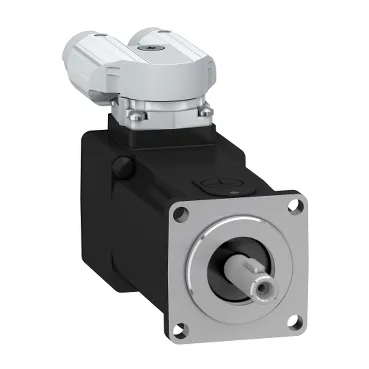
The SH30402P17A2000: This SH3 frame servo delivers 0.31 N.m nominal torque and 275 W output power when fed from a 400 V three-phase supply, with the same torque figure at 480 V for 289 W output. On single-phase 115 V or 230 V the nominal torque drops to 0.292 N.m and output power to 152 W — the winding is optimized for three-phase line voltage, so a single-phase feed derates both torque and speed range. Maximum mechanical speed is 9000 rpm regardless of supply, but the back EMF constant of 18 V/krpm at 20 °C means the drive's DC bus must stay above the generated voltage at top speed; a 400 V bus gives roughly 560 V DC, leaving about 380 V headroom above the 162 V back EMF at 9000 rpm — adequate provided the drive's voltage margin holds under load. Peak stall torque reaches 1.5 N.m at 480 V three-phase with a 7.2 A peak current — this is the short-term overload for acceleration through a cycle, not continuous duty. The continuous stall torque is 0.39 N.m at 1.5 A, so the motor can hold position indefinitely at that torque without exceeding the 120 °C copper temperature rating. The torque constant of 0.26 N.m/A at 120 °C hot copper means the continuous stall current of 1.5 A produces 0.39 N.m; at peak current the torque constant holds linearly provided the drive current loop saturates below the stator resistance drop of 11.6 Ω.
Encoder feedback and position hold without brake
The absolute multiturn SinCos Hiperface encoder (16 periods per revolution) retains position across power cycles — no homing sequence on restart, which matters for applications where a lost-home condition would scrap a workpiece or require manual re-referencing. The multiturn count tracks absolute position over multiple shaft revolutions, so a power interruption mid-cycle does not lose the axis coordinate. This encoder type uses sine-cosine analog tracks interpolated to 16-bit resolution; the drive must support Hiperface protocol to decode the position.
Mounting, sealing, and thermal management
The motor mounts on a 40 mm international standard flange with four 4.5 mm mounting holes on a centring collar of 30 mm diameter and 2.5 mm depth — this matches the IEC 72-1 flange pattern for 40 mm frame servo motors. The shaft is 8 mm diameter with a 25 mm length and a 3 mm parallel key; the keyway is cut to standard depth for the 8 mm shaft class. Overall length is 93.4 mm from the flange face to the rear connector, which is a rotatable right-angle connector — the connector body can be oriented in 90° increments to route the cable along the axis or at right angles, useful in tight cable-tray layouts. IP rating depends on the shaft seal configuration: with the shaft seal ring fitted the motor achieves IP65 per IEC 60034-5, suitable for washdown environments. Without the seal ring the shaft bushing is IP54 — fine for dry indoor cabinets but not for direct spray. Cooling is by natural convection only, so the continuous torque rating of 0.39 N.m assumes free air circulation around the frame; mounting the motor inside a confined enclosure or against a heat sink reduces the thermal margin. The stator inductance of 6.4 mH and resistance of 11.6 Ω set the electrical time constant at about 0.55 ms, which the drive current loop must handle without oscillation.