290 W, 40 mm flange — what fits where
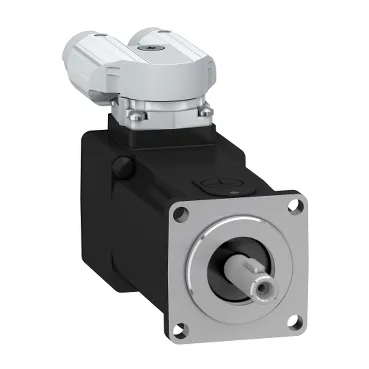
The SH30402P17A2100 is a 290 W continuous power servo motor from the SH3 family, built on a 40 mm international standard flange. It delivers 0.31 N.m nominal torque at 480 V three-phase and spins to 9000 rpm, making it a fit for compact positioning axes in pick-and-place, labelling, or small conveyor drives. The motor carries an absolute multiturn SinCos Hiperface encoder with 16 periods of speed feedback resolution — no homing cycle needed on power-up, which matters for multi-axis gantries where lost position means a re-teach. IP65 rating on both the motor body and the shaft bushing means it handles washdown environments on food or packaging lines without a secondary cover.
Connector, cooling, and shaft details
The electrical connection is a rotatable right-angled connector — useful when cable exit direction has to clear neighbouring hardware in a tight cabinet. Cooling is natural convection, so no forced-air clearance or fan maintenance; the motor relies on its own surface area and the machine's ambient airflow. Shaft is 8 mm diameter with a 25 mm length and a parallel key (3 mm key width). The centring collar is 30 mm diameter with a 2.5 mm depth — standard for 40 mm flange motors, so it drops into existing mounts without adapter plates.
Electrical parameters — torque, current, and thermal limits
Continuous stall torque is 0.39 N.m across the 115–480 V three-phase range, with a continuous stall current of 1.5 A. Peak stall torque hits 1.5 N.m at 480 V three-phase, drawing 7.2 A for up to 3 seconds — enough for acceleration bursts without tripping the drive's I²t limit. Stator resistance is 11.6 Ohm and inductance is 12.8 mH — these set the electrical time constant and influence the drive's current-loop tuning. Torque constant is 0.26 N.m/A at 120 °C copper hot, which is the realistic operating temperature for continuous duty. Back EMF constant is 18 V/krpm at 20 °C — at 9000 rpm the motor generates 162 V line-to-line, which must stay below the drive's DC bus voltage for proper current regulation.