Speed-torque envelope across supply voltages
The SH30552P02F2200 delivers nominal speed that scales with supply: 2000 rpm on 115 V single phase, 4000 rpm on 230 V single phase, and 6000 rpm on 400 V or 480 V three phase. Nominal torque drops from 0.77 N.m at 115 V to 0.63 N.m at 400/480 V three phase, so the torque-per-amp tradeoff shifts with the input rail you have on site. Peak stall torque is 2.5 N.m across the 115–480 V three-phase range, giving you a 3.2× overload margin above the 0.77 N.m nominal — enough for short acceleration bursts on a pick-and-place gantry without tripping the drive's current limit.
Encoder feedback and tuning implications
This motor carries an absolute multiturn SinCos Hiperface encoder — the multiturn count tracks position through power cycles, so homing on power-up is unnecessary on a machine that parks in a known position. SinCos interpolation gives the drive fine velocity feedback, which helps the current loop settle faster on low-inertia loads.
Mounting, shaft, and environmental sealing
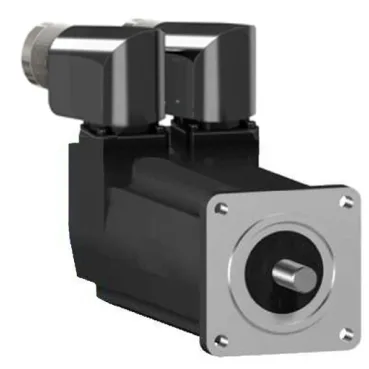
The motor uses a 55 mm (2.2 in) international standard flange with a 40 mm centring collar and 5.5 mm mounting holes — fits the common B5-style mounting pattern for servo motors in that frame size. The smooth shaft is 9 mm diameter with a 20 mm shaft length, so couplings or pulleys need a clamping bore, not a keyway. IP65 on the motor body and shaft bushing, IP67 on the housing — the shaft bushing seal is the wet-end barrier, so washdown applications need the connector mated and the sealing washer seated. Natural convection cooling means no fan noise, but the 530 W continuous power assumes free airflow around the flange; derate if enclosed in a tight cabinet.
Electrical parameters and connection
Stator resistance is 17.4 Ω and inductance is 53.54 mH — the high inductance limits current ripple at the drive's PWM frequency, which helps keep the motor cool at low speeds. Maximum current Irms is 4.8 A, and the 3 s peak output matches that same 4.8 A, so the drive's current limit should be set to 4.8 A RMS to protect the windings. The electrical connection is a rotatable right-angled connector — useful when the cable exit needs to point toward the cable tray rather than straight out the back. Torque constant is 0.59 N.m/A at 120 °C copper temperature, so at the 4.8 A peak you get 2.83 N.m theoretical — slightly above the 2.5 N.m peak stall spec, meaning the motor is thermally limited before the magnetic circuit saturates.