Speed and torque across supply voltages
The SH30552P02A1000: This SH3 frame motor delivers its top speed — 8000 rpm — only on three-phase supplies (400 V or 480 V). On single-phase 115 V it tops out at 2000 rpm; on 230 V single-phase it reaches 4000 rpm. The nominal torque follows a similar curve: 0.77 Nm at 115 V single-phase, 0.75 Nm at 230 V single-phase, and 0.63 Nm on either three-phase supply. That means the application voltage determines both the speed ceiling and the available torque — a machine designed for 8000 rpm on 480 V will not reach that speed on a single-phase line. Continuous power is 530 W, with nominal output power varying from 160 W (115 V single-phase) up to 670 W (480 V three-phase). The continuous stall torque is 0.71 Nm across the three-phase range, and the peak stall torque hits 2.5 Nm — useful for short acceleration bursts or overcoming static friction at startup.
Encoder, feedback, and control loop fit
The absolute multiturn SinCos Hiperface encoder gives position feedback without a homing cycle after power loss — the multiturn count is retained. This matters for applications like gantry axes or rotary tables where the machine must know its position immediately on power-up. The SinCos analog track also provides velocity feedback with low jitter for the servo drive's current loop. The torque constant is 0.59 Nm/A at 120 °C copper temperature, and the back EMF constant is 40 V/krpm at 20 °C. These two numbers let the drive calculate the motor's electrical model for field-oriented control. The stator resistance is 17.4 Ω and inductance is 53.54 mH — a relatively high inductance that limits current ripple at higher switching frequencies.
Mechanical interface and mounting constraints
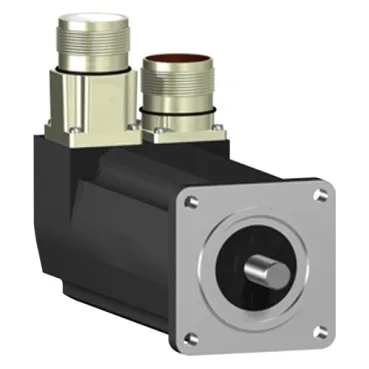
The motor flange is 55 mm (2.2 in) with an international standard flange pattern. The centring collar is 40 mm diameter, 2 mm deep. Mounting holes are 5.5 mm diameter on the flange face. The shaft is 9 mm diameter, 20 mm long, smooth — no keyway. If the load requires a keyed coupling, you will need a shaft adapter or a different motor variant. Overall length is 154.4 mm (6.08 in). The IP rating is IP54 at the shaft bushing without the shaft seal ring, and IP65 on the motor body and with the shaft bushing seal ring fitted. For washdown or dusty environments, specify the shaft seal ring option. The electrical connection is a straight connector — plan cable routing accordingly; a right-angle connector would need a different motor variant. Maximum radial force is speed-dependent: 370 N at 1000 rpm, dropping to 190 N at 8000 rpm. Maximum axial force is 40 N. These limits govern belt-drive or direct-coupling designs — exceeding them at high speed shortens bearing life.
Thermal and current limits
The motor is naturally convection-cooled — no fan, so the continuous current rating of 1.2 A (stall) and 4.8 A (maximum continuous Irms) assumes free airflow around the housing. The hot-spot copper temperature is rated at 130 °C. In a confined panel or with restricted airflow, derate the continuous current or add forced ventilation. The 3-second peak current is also 4.8 A — the drive's current limit should be set to this value to avoid demagnetization.