Power and speed envelope across supply voltages
The SH30552P02F1000 delivers 530 W continuous power, but the nominal output power varies with the supply: 160 W on 115 V single-phase, 310 W on 230 V single-phase, 600 W on 400 V three-phase, and 670 W on 480 V three-phase. The nominal speed also shifts — 2000 rpm at 115 V single-phase, 4000 rpm at 230 V single-phase, and 8000 rpm at both 400 V and 480 V three-phase. That means the same motor frame covers a wide application range, but the torque-speed curve is supply-dependent; a 115 V line limits both speed and power, so sizing must account for the actual incoming voltage, not just the motor nameplate. Nominal torque follows the same pattern: 6.82 lbf.in (0.77 N.m) at 115 V single-phase, 6.64 lbf.in (0.75 N.m) at 230 V single-phase, and 5.58 lbf.in (0.63 N.m) at both 400 V and 480 V three-phase. The continuous stall torque is 6.28 lbf.in (0.71 N.m) across the 115-480 V three-phase range, and the peak stall torque reaches 22.1 lbf.in (2.5 N.m) — about 3.5× the continuous stall figure, which is typical for short-duration acceleration or overcoming static friction.
Encoder, brake, and feedback for position-critical axes
The absolute multiturn SinCos Hiperface encoder provides position feedback without a home cycle after power loss — the multiturn count is retained. This is the deciding factor for vertical axes or any application where re-referencing after a power cycle is unacceptable. The Hiperface protocol is a common interface on Schneider drives and many third-party servo drives, but confirm the drive's encoder input compatibility before committing. The holding brake is integrated, rated at 7.08 lbf.in (0.8 N.m) holding torque. That matches the continuous stall torque, so the brake holds the load at standstill without back-driving through the gearbox. The shaft is smooth (no keyway), 9 mm diameter, 20 mm length — the brake engages when power is removed, so the axis stays put on a power loss without a mechanical lock.
Mounting, cooling, and environmental sealing
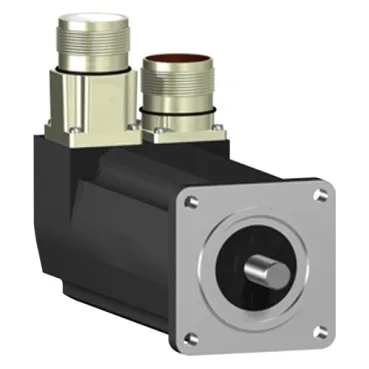
The motor uses an international standard flange with a 55 mm square pattern and 5.5 mm mounting holes; the centring collar is 40 mm diameter, 2 mm deep. That is a common frame size for small servo motors — mates with standard gearbox input flanges in the 40-55 mm range. The overall length is 181 mm (7.1 in), which is compact for a motor with an integrated brake and multiturn encoder. Cooling is by natural convection — no fan, so the motor relies on its surface area and the mounting flange for heat dissipation. In a confined enclosure or at high duty cycles, the copper temperature hot spot is rated at 266 °F (130 °C); the torque constant is specified at 248 °F (120 °C), so thermal derating is built into the published torque figures. The IP rating is IP54 at the shaft bushing without a shaft seal ring, and IP65 when the shaft bushing includes the seal ring — the motor body itself is IP65 per IEC 60034-5. For washdown or dusty environments, specify the shaft seal option.
Electrical parameters and drive sizing
The maximum mechanical speed is 9000 rpm, but the electrical speed is limited by the back EMF and the drive's DC bus voltage — at 480 V three-phase, the nominal speed is 8000 rpm, so there is about 12.5% headroom before the drive hits its voltage limit. The number of motor poles is 3 (a 3-pole pair, i.e. 6-pole motor), which gives a base speed of 8000 rpm at 400 Hz electrical frequency. The electrical connection is a straight connector — no right-angle or flying leads, so plan the cable routing and strain relief accordingly.