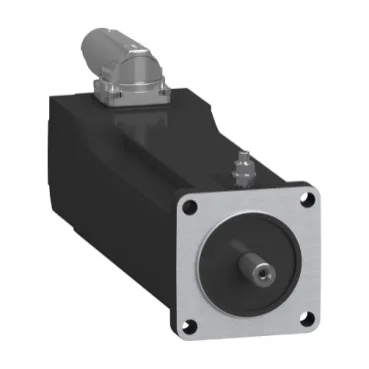
What the SH30552P0AF4000 actually delivers on the shaft
The Schneider Electric SH30552P0AF4000 is a SH3-series servo motor with holding brake built on a 55 mm international-standard flange, sized for 530 W of continuous mechanical output and 0.75 N.m of nominal torque at 230 V single phase. That continuous rating is the number to size the application against — not the peak stall torque of 2.5 N.m at 115...480 V three phase, which is only available as a transient overload. Nominal speed scales with the supply: 4000 rpm at 230 V single phase, 8000 rpm at 400 V three phase, and 9000 rpm at 480 V three phase, with the 9000 rpm ceiling also the maximum mechanical speed the bearings and balance are rated for.
Torque, current, and thermal envelope
The torque constant of 0.59 N.m/A at 120 °C winding temperature is the conversion factor between commanded current and shaft torque, and the 4.8 A Irms peak / 4.8 A 3-second peak output current are the same ceiling the drive must respect on acceleration ramps. Cooling is natural convection only, so any enclosure that traps heat around the motor body will erode that continuous figure — derate against the IEC 60034 thermal class rather than assuming the nameplate in still air transfers cleanly into a sealed cabinet.
Encoder, brake, and electrical interface
Feedback is an absolute single-turn Hiperface DSL encoder on a quicklock rotatable right-angled connector — single-cable topology, so only one hybrid cable runs between drive and motor rather than separate power and resolver/encoder pairs.
Mechanical limits the mechanical designer has to respect
The shaft sees a maximum radial force of 190 N at 8000 rpm and a maximum axial force of 40 N — the numbers a belt drive, pinion, or coupling has to be checked against, with the radial figure derating as speed rises. Sealing is IP65 on the motor body and IP54 at the shaft bushing when no shaft seal ring is fitted, per IEC 60034-5 — adequate for typical machine interiors, not for direct washdown or outdoor exposure where the IP54 shaft end would be the weak link. Mounting is via the international standard flange with 5.5 mm mounting holes on the 55 mm bolt circle, and the stator electrical data of 17.4 Ohm phase resistance and 18.2 mH phase inductance is what the drive's auto-commissioning routine will read back during first-time setup.