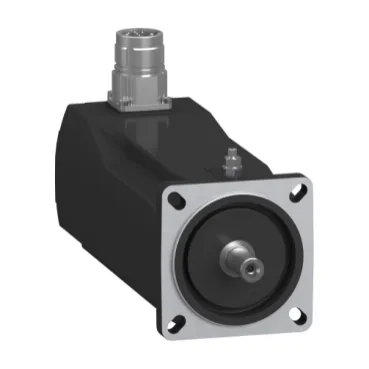
The SH30701P0AF3100 is a three-phase servo motor from the SH3 family, delivering 690 W nominal output power at 400 V or 480 V three-phase supply, with a peak speed of 7200 rpm on 480 V. On a 230 V single-phase line it produces 370 W and tops out at 3000 rpm — so the supply voltage directly governs both the power and speed envelope available to the axis. The integrated holding brake holds 3 N·m (26.6 lbf·in) with 7 W pull-in power. That means a vertical or inclined axis stays put when power is removed, without needing an external brake resistor or a separate mechanical brake — the brake is sized to hold the rated continuous stall torque (1.25 N·m) plus margin. The absolute single-turn Hiperface DSL encoder eliminates the need for a homing sequence on every power-up — the position is known immediately. This matters for applications where the machine must resume operation after a power cycle without re-referencing, such as pick-and-place or rotary indexing stations.
Torque, inertia, and thermal limits — sizing the axis correctly
Nominal torque is 1.4 N·m on 230 V single-phase, dropping to 1.1 N·m on 400/480 V three-phase — the motor delivers higher torque at lower voltage because the current limit is the same but the voltage-dependent speed is lower. Peak stall torque reaches 3.5 N·m across the 115–480 V three-phase range, giving a 3:1 peak-to-continuous ratio for acceleration bursts. The motor is cooled by natural convection only — no fan or forced air. Continuous stall current is 1.8 A, and the maximum continuous current (Irms) is 5.7 A. The thermal limit at the copper winding is 130 °C (266 °F), so the duty cycle must stay within the continuous torque curve unless the application allows the winding to cool between cycles.
IP65, flange mount, and shaft — integration constraints
The motor and shaft bushing are rated IP65 per IEC 60034-5, meaning the housing is dust-tight and protected against low-pressure water jets. This suits washdown environments in food processing, packaging, or outdoor machine stations — but the connector must be mated with the matching IP65-rated cable assembly to maintain the seal. Mounting is via an international standard flange with a 70 mm flange size and a 60 mm centring collar diameter. The four mounting holes are 5.5 mm diameter on a bolt circle matching the 70 mm flange pattern — standard for IEC frame sizes. The smooth shaft (11 mm diameter, 23 mm long) accepts a clamping-type coupling; no keyway is provided. Maximum radial force at the shaft is 730 N at 1000 rpm, derating with speed. Maximum axial force is 80 N. These limits govern the coupling selection and the overhung load from a belt or gear — exceeding them shortens bearing life or causes shaft deflection that the encoder reads as position error.