Speed and torque across the voltage range
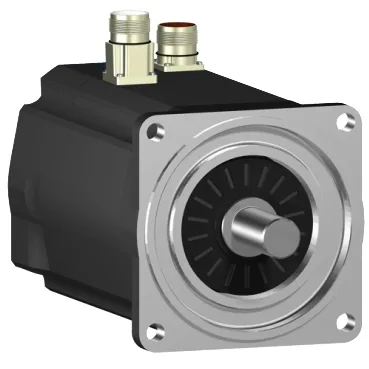
The SH31001M11F1000: This motor's nominal speed depends on what line voltage you feed it: 625 rpm on 115 V single-phase, 1250 rpm on 230 V single-phase, 2500 rpm on 400 V three-phase, and 3000 rpm on 480 V three-phase. That means the same frame covers both a low-speed indexing station and a higher-speed conveyor pick — just match the drive voltage to the target speed. Nominal torque also shifts with supply: 2.8 N·m at 115 V single-phase, 2.71 N·m at 230 V single-phase, and 2.52 N·m at both 400 V and 480 V three-phase. The torque drop from single-phase to three-phase is about 10 %, so if the load needs the full 2.8 N·m, you stay on 115 V single-phase; if speed matters more, you go three-phase and accept the slight torque reduction.
Brake and encoder — what they lock in
The holding brake delivers 9 N·m (79.7 lbf·in) — enough to hold a vertical-axis load stationary when the drive is off. That brake is integral, not a bolt-on, so the motor length is fixed at 199.5 mm including the brake section. Feedback comes from an absolute single-turn SinCos Hiperface encoder. Single-turn means the position is known within one revolution after power-up — no homing cycle needed for rotary tables or pick-and-place axes that never rotate more than 360°.
Environmental sealing and mounting
The motor carries IP54 at the shaft bushing without the shaft seal ring, and IP65 with the seal ring fitted. IP65 means it handles washdown spray from any direction — suitable for food, beverage, or wash-down zones where the motor gets hosed down. Mounting is via a 100 mm international standard flange (IEC 60034-5) with a 95 mm centring collar and four 9 mm mounting holes. The shaft is 19 mm diameter with a parallel key, 40 mm shaft length — a standard NEMA/IEC interface that mates with most gearboxes and couplings without an adapter plate.