Speed and torque depend on supply voltage
The SH31002M12F2100: This motor's nominal speed shifts with the supply: 500 rpm on 115 V single-phase, 1000 rpm on 230 V single-phase, 2000 rpm on 400 V three-phase, and 2400 rpm on 480 V three-phase. The nominal torque also varies — 5.62 N.m at 115 V single-phase, 5.5 N.m at 230 V single-phase, and 5.28 N.m at both 400 V and 480 V three-phase.
Holding brake and encoder for vertical-axis duty
The integrated holding brake delivers 9 N.m holding torque — enough to hold a vertical load on a Z-axis or gantry when the drive is disabled. The absolute multiturn SinCos Hiperface encoder means the controller knows the shaft position at power-up without a homing move, which saves cycle time on machines that power-cycle between batches.
Peak torque and thermal limits for sizing
Peak stall torque is 18.3 N.m across the 115–480 V three-phase range, with a 3-second peak current of 9.0 A. Continuous stall torque is 5.8 N.m. The motor is naturally convection-cooled (no fan), so the continuous torque is the limit for sustained duty cycles — the peak figure is for acceleration transients only.
Mounting and environmental fit
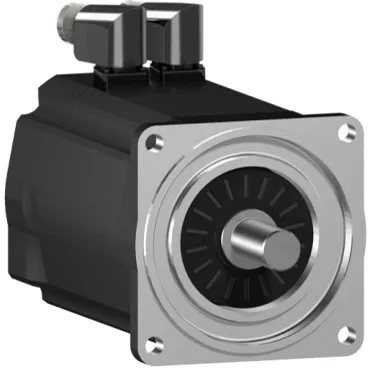
The motor uses an international standard flange with a 100 mm flange size and 95 mm centring collar. The shaft is 19 mm diameter with a parallel key, 40 mm shaft length. IP65 rating on both the motor body and shaft bushing means it handles washdown environments — the rotatable right-angled connector lets the cable exit in the direction that suits the cable tray.
Force limits for direct-drive loads
Maximum radial force on the shaft drops with speed: 990 N at 1000 rpm, 790 N at 2000 rpm, 690 N at 3000 rpm, 620 N at 4000 rpm. Maximum axial force is 160 N. If the load applies radial force through a belt or pulley, these limits set the bearing life — exceeding them shortens service intervals.