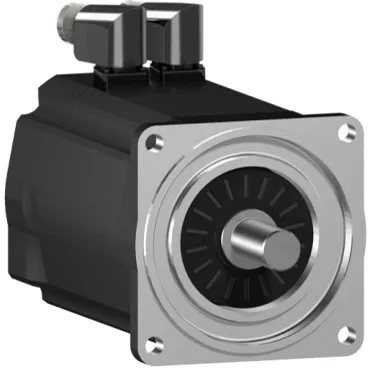
What the speed and torque specs mean for your drive pairing
This SH31002M12F2000 servo motor delivers a nominal speed that depends on the supply: 500 rpm on 115 V single-phase, 1000 rpm on 230 V single-phase, 2000 rpm on 400 V three-phase, and 2400 rpm on 480 V three-phase. If you're running it on a 400 V three-phase drive, you'll get 2000 rpm nominal — match that to the load's required speed range and the drive's velocity loop bandwidth. The nominal torque varies similarly: 5.62 N.m at 115 V single-phase, 5.5 N.m at 230 V single-phase, and 5.28 N.m at both 400 V and 480 V three-phase. The peak stall torque is 18.3 N.m across the 115...480 V three-phase range — that's the short-term overload headroom for acceleration or overcoming friction during startup.
Absolute multiturn encoder — no homing sequence on power-up
The encoder is an absolute multiturn SinCos Hiperface type. That means the motor remembers its shaft position after a power cycle — no need to run a homing routine at startup. The SinCos interface gives high-resolution position feedback for the drive's current loop, and the Hiperface protocol carries the multiturn count over the same pair of wires. Pair it with a drive that supports Hiperface; the wiring is a shielded twisted pair plus the motor power leads.
IP54 or IP65 — depends on the shaft seal
The motor carries IP54 on the shaft bushing without the shaft seal ring, and IP65 on the motor body and shaft bushing with the seal ring installed. If this motor is going into a washdown zone, you need the shaft seal ring fitted — otherwise the IP54 rating means it's splash-resistant but not hose-down safe. The connector is a rotatable right-angle type, which helps route the cable in tight enclosures without stressing the gland.