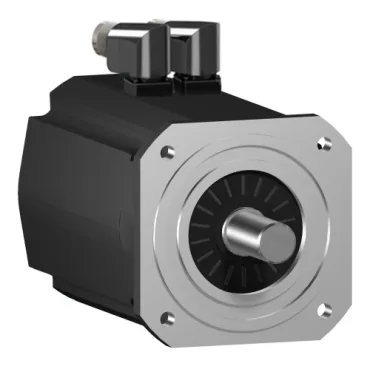
What the SH32051P02A2100 actually is
The Schneider SH32051P02A2100 is a three-phase AC servo motor from the SH3 sizing family, built around a 205 mm international-standard flange and measuring 321 mm long with a 38 mm smooth shaft that protrudes 80 mm out of the housing.
Power and torque envelope across the three voltage classes
Continuous output power sits at 5500 W on 400 V three phase and 5200 W on 480 V three phase, but the same frame only delivers 2510 W on 115 V single phase and 4240 W on 230 V single phase — the motor is sized for a 400 V three-phase feed, with the lower voltages listed as derated operating points, not headline ratings. Nominal torque follows the same shape: 31.9 N.m at 115 V single phase, 27 N.m at 230 V single phase, 17.5 N.m at 400 V three phase, and 13.8 N.m at 480 V three phase, paired against nominal speeds from 750 rpm at the lowest voltage class up to 3600 rpm on 480 V three phase. Selecting the frame for the application means matching the torque-at-speed point to the mechanical duty, not the headline power number.
Mechanical fit and on-machine load limits
Shaft loading is bounded at 3730 N radial at 1000 rpm, dropping to 2960 N at 2000 rpm and 2580 N at 3000 rpm, with a maximum axial force of 740 N — direct-coupled loads are well inside the envelope, but a belt or pinion drive has to be checked against the radial curve at the actual operating speed before sign-off.
Encoder feedback and electrical interface
The Hiperface SinCos absolute multiturn encoder resolves position via one-cycle SinCos analog tracks plus a digital protocol channel, so the drive end needs to support Hiperface — pairing the SH32051P02A2100 against a drive that only takes incremental encoders means the multi-turn retention is lost and a homing routine has to be added on every power-up. Electrical termination is a rotatable right-angled connector, which lets the installer orient the cable exit after the motor is bolted down — a small but useful detail on cramped machine layouts where the cable drop direction is fixed by the harness, not the motor.
Environment, cooling, and what the frame is rated to take
Cooling is natural convection with no integrated fan, which keeps the acoustic signature low and removes a maintenance item — but the continuous torque has to be derated in any enclosure where the ambient around the motor body rises above the reference figure.